Insights
Vrbo's 30-Day Rule Is a Claim on Relationships It Didn't Build
From October 29, Vrbo can charge commission on direct bookings it never processed. What the 30-day clause does, who it hurts, and what operators should demand.
Petar Ojdrovic
Yada
·
8 min read

On October 29, Vrbo gives itself the right to charge hosts commission on bookings it never processed, through channels it doesn’t own, with no clear line between guests it introduced and guests the host already knew. The mechanism is a 30-day window buried in its new host terms. It is an extraordinary reach into the host–guest relationship, and every operator in this industry should understand exactly what it means.
What the clause does
Under Vrbo’s new terms, if a guest contacts a host through Vrbo and, as a result, books directly with that host within 30 days, Vrbo can charge its commission on that direct booking.
Read that again. The booking happens on the host’s website, through the host’s payment processor, with a guest who has already chosen the host. Vrbo’s checkout is never involved. Its role is a single message thread.

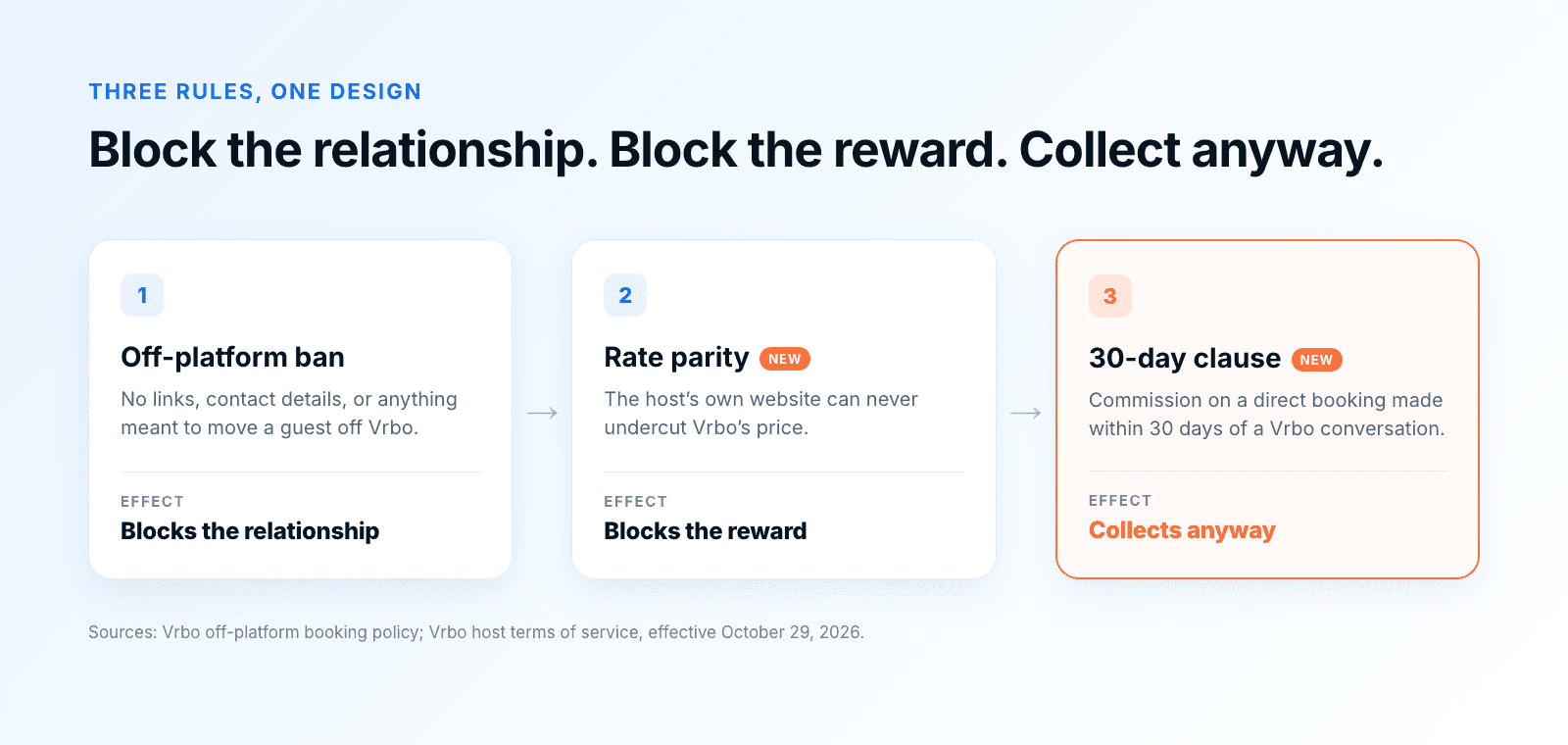
That clause doesn’t stand alone. Vrbo already prohibits hosts from sharing links, contact details, or anything intended to move a guest off the platform. The new terms add rate parity, so a host’s own website can never undercut Vrbo’s price. Taken together, the design is clear: block the host from building a direct relationship, prevent them from rewarding one, and when a guest finds their way to the host anyway, collect on it.
Why 30 days, and why now
The window is not arbitrary. A guest who sends a question before booking is a guest in the middle of a decision. They have found a property they like, and they are checking the details: the crib, the parking, the pet policy, whether the grill works. That moment of consideration is exactly when a guest is most likely to look the host up, find their website, and book.

A 30-day claim is designed to capture that moment. It reaches across the period when a guest is actively deciding and turns the platform’s message thread into a toll gate on whatever the guest does next.
The timing matters too. Vrbo announced this change on September 29, alongside a move to a flat 12% commission for every host. The fee increase got the headlines. The 30-day clause did not. That is not an accident of communications. A fee increase is easy to understand and easy to price around. A claim on off-platform revenue is harder to see, harder to explain, and far more consequential for any operator trying to build a business that outlasts a single marketplace.
Vrbo is paid for bookings. Now it wants to be paid for conversations.
Vrbo’s model is called pay-per-booking for a reason. Hosts agreed to a simple deal: when Vrbo delivers a booking, Vrbo takes a commission. The fee has always been tied to a completed transaction, priced and collected at checkout.
The 30-day clause rewrites that deal. It ties the fee not to a booking Vrbo completed, but to a conversation Vrbo hosted. That is a fundamental change in what hosts are paying for.

Give Vrbo its strongest case. A traveler who had never heard of a property finds it on Vrbo, asks a question, and books with the host directly a week later. Vrbo can fairly say it made that match. If the clause were limited to that scenario, with a clear definition and a transparent process, it would still be a change worth contesting, but it would at least be coherent.
That is not the clause Vrbo wrote. It doesn’t distinguish between a stranger Vrbo introduced and a guest the host already knew. A family who has booked directly with a host for five summers, and happens to send a question through Vrbo this year, looks the same under these terms as a first-time traveler. “As a result” is undefined. And Vrbo, the party collecting the fee, is the one deciding which bookings it caused.
The question isn’t whether a marketplace deserves to be paid for a genuine introduction. It’s whether a marketplace gets to decide, unilaterally and without explanation, which of your guests it introduced. Vrbo’s new terms answer that question in Vrbo’s favor.
Vrbo’s argument, and why it doesn’t hold
Vrbo will defend the clause. The arguments are predictable, and none of them survive scrutiny.
“We made the introduction.” Sometimes Vrbo did. Not always. A guest who stayed with a host before, found them through search, or was referred by a friend may still send a question through Vrbo simply because the listing was in front of them. The clause treats all of those guests the same, and Vrbo hasn’t explained how it tells them apart. A fee for genuine introductions is a negotiation. A fee for every guest who ever passed through the platform’s inbox is a land grab.
“Hosts are free-riding on our marketing.” Vrbo already bans hosts from sharing links, contact details, or anything designed to move a guest off the platform. If a host were actively diverting guests, Vrbo has existing rules for that. The 30-day clause reaches past steering. It applies when a guest, on their own initiative, decides to book directly. That is not free-riding. That is a customer making a choice.
“Our fees are lower than competitors’.” Perhaps. But a lower headline rate does not justify a claim on revenue the platform never processed. A lower toll on the highway does not entitle the operator to bill you for the side roads.
Strip away the framing and one argument remains: Vrbo wants to be paid whenever a guest who touched its platform spends money with a host. That is not a marketplace fee. It is a claim of ownership over the customer.
It penalizes the hosts who make Vrbo worth using
The hosts most exposed to this clause are the best ones on the platform. They respond quickly. They answer questions thoroughly. They deliver stays guests want to repeat. Those are precisely the behaviors that produce a pre-booking conversation followed by a direct return booking.
The disengaged host who ignores messages and never earns a repeat guest is untouched. The professional operator who treats every inquiry as an opportunity is the one who pays.
That is a perverse incentive for a company whose entire product depends on host quality. Vrbo has put a price on responsiveness. It should not be surprised if hosts start to calculate it.
Travelers lose too
This clause is framed as a host issue. It is also a guest issue.
Travelers ask questions because they want to make a good decision for their family. Will the stairs work for my father? Is the yard fenced for the dog? Can we check in late after a delayed flight? The best hosts answer those questions generously, because that is what hospitality is.

When a platform attaches a financial consequence to that conversation, it changes the conversation. Answers get shorter. Hosts get guarded. The traveler, who simply wanted to know whether the crib would be there, ends up with a worse experience and no idea why.
A marketplace that claims to put travelers first should not be building rules that make hosts think twice before helping them.
What this is really about
This is not a pricing decision. It is a strategic one.
The most valuable asset in hospitality is the guest relationship: the name, the history, the preference for the corner room or the dog-friendly listing, the likelihood of returning next summer. Hotels learned this over decades of fighting OTA dependency, and the brands that won did it with loyalty programs and direct relationships the intermediaries could not touch.

Short-term rental platforms have studied the same history and drawn the opposite conclusion. Airbnb already prohibits hosts from encouraging repeat guests to book off-platform. Vrbo has now gone further, asserting a financial claim on what happens after a guest leaves its ecosystem. The direction of travel is unmistakable. The platforms do not intend to be a distribution channel that hosts use. They intend to be the owner of the customer, with hosts as interchangeable supply.
Operators who accept that framing will spend the next decade paying rising fees to rent access to their own guests.
What operators should demand
Operators, management companies and industry associations should not accept this clause quietly. At a minimum, Vrbo owes its hosts clear answers to the following:
A precise definition of “as a result.” Which conversations create a claim? A single question about parking? A message the host never answered? An inquiry from a guest who had already stayed with the host before?
An exclusion for existing relationships. A guest who stayed with a host directly before ever touching Vrbo is the host’s customer. No platform message should change that.
Transparency on attribution. If Vrbo intends to identify direct bookings on a host’s own channels, hosts deserve to know exactly how, using what data, and on what basis.
A real dispute process. Any claim on off-platform revenue should come with a clear, independent way for the host to contest it.
A defined purpose. If the clause exists to prevent steering, Vrbo should limit it to steering. Its existing off-platform policy already addresses that.
These are not radical asks. They are the minimum any business would expect from a partner claiming a share of its revenue.
Own the relationship before the platform can claim it
The 30-day clause works only because the platform sits between host and guest. The answer is to stop letting it sit there.

Build a guest base you own. Direct bookers, past guests who opted in, visitors to your own site. That list is the business, and it belongs to you.
Stay present between stays. Guests who hear from you directly don’t return to a marketplace to find you. They book with you.
Make loyalty worth something. Platforms can restrict discounts. They cannot replicate recognition: returning-guest benefits, personal service, and the experience of being known.
Be findable on your own terms. Your brand, your site, your search presence. Every guest who reaches you without an intermediary is one no platform can bill you for.
This is the work Yada exists to do. We give operators a guest data platform they own, marketing that keeps them in front of past guests, and loyalty that turns a single stay into a lasting relationship — the infrastructure the platforms would prefer hosts never build.
Vrbo has made its position clear. It believes your guests are its customers. We believe they’re yours, and we’re building the tools to prove it.
See how Yada puts operators back in control of their guests →
Sources
Vrbo Host Terms of Service, effective Oct 29, 2026 — the 30-day clause, host reporting, rate parity
Vrbo Off-Platform Booking Policy — the steering ban
Futurestay: Vrbo’s 12% Commission (Oct 2, 2026) — summary of the new terms