Insights
Stop Calling It Direct Booking. Call It Owning Your Customer.
“Direct booking” frames the fight as a choice between checkouts, which platforms win. Owning your customer moves it to the relationship they can’t touch.
Petar Ojdrovic
Yada
·
5 min read

The short-term rental industry has spent years talking about “direct booking.” It’s time to retire the phrase. It describes the wrong thing, and it has quietly let the platforms set the terms of the debate.
Direct booking is a channel. Owning your customer is a strategy.
“Direct booking” describes where a transaction happens: your website instead of a marketplace. It frames the question as a choice between checkouts, and on those terms, the platforms are comfortable. They can match a checkout. They can require rate parity. They can claim a commission on a direct booking that follows a conversation on their platform, as Vrbo’s new terms now do.
Owning your customer is a different idea entirely. It means you know who your guests are, you can reach them without permission from an intermediary, and you have a reason for them to come back to you. The booking is just the moment that relationship produces revenue.

A direct booking without an owned relationship is a one-off. An owned relationship produces direct bookings for years.
How the language trapped the industry
Words shape strategy. “Direct booking” has shaped operators’ strategy in three unhelpful ways.
First, it makes the argument about price. If the only difference between a platform booking and a direct booking is the checkout, the obvious way to win direct is a lower rate. The platforms saw that coming. Rate parity clauses, like the one in Vrbo’s new terms, exist to shut that door.
Second, it makes direct booking sound like a favor. Operators find themselves asking guests to book direct, offering a few dollars off, explaining why it helps the host. The guest is being asked to do the operator a kindness rather than being offered a better relationship.
Third, it treats each booking in isolation. A direct booking strategy optimizes for the next reservation. It says nothing about whether that guest will ever return, refer a friend or hear from you again. It is a transactional answer to a relationship problem.
The platforms are very comfortable fighting on that ground. Operators shouldn’t be.
Every other industry already made this shift
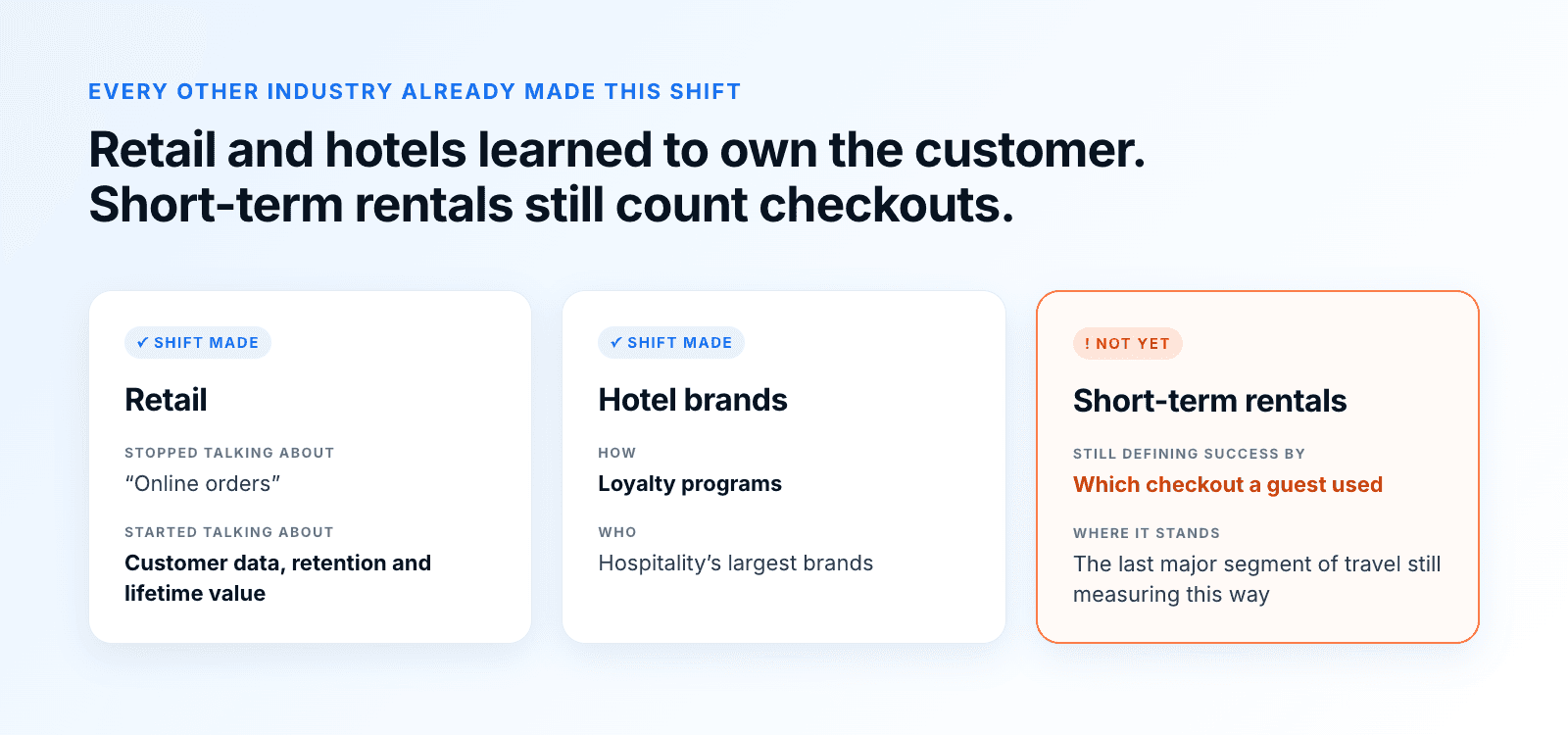
Retail stopped talking about “online orders” and started talking about customer data, retention and lifetime value. That is the shift that made Shopify, Klaviyo and the direct-to-consumer movement possible. The brands that won didn’t just have a website. They owned their customer list, they marketed to it, and they made the marketplace one acquisition channel among many.
Hospitality’s largest brands made the same shift with loyalty programs. Short-term rental operators are the last major segment of travel still defining success by which checkout a guest used.
What Shopify got right
Shopify’s ambition was famously framed as “arming the rebels.” The rebels were independent merchants. The empire was the giant marketplace that wanted every purchase to run through its checkout, every customer relationship to sit in its database, and every merchant to compete in its search results on its terms.
Shopify didn’t tell merchants to abandon marketplaces. It gave them the tools to build something marketplaces couldn’t take away: their own storefront, their own brand, and above all their own customer list. Around it grew an ecosystem of tools for email, loyalty and retention that let merchants turn a first purchase into a long relationship.

The result was a generation of brands that treated marketplaces as one channel among many. They used them to reach new customers, and then they owned those customers forever after.
Hospitality never got its version of that moment. Short-term rental operators have booking engines and channel managers, tools for getting a reservation into a calendar. What they have lacked is the layer that makes the customer theirs: the data, the marketing and the loyalty that turn guests into regulars. That layer is the difference between selling stays and owning a business.
What owning your customer actually requires
Identity. Know who stayed with you, across every property and every channel you control.
History. Which property, which dates, who they traveled with, what they loved, what they spent.
Permission. Guests who have opted in to hear from you, reachable on your terms.
A reason to return. Loyalty, recognition and perks that make coming back to you the obvious choice.
Measurement. Repeat rate, direct share and guest lifetime value, tracked the way a retailer tracks them.
None of those are features of a booking engine. They are features of a business that owns its customers.
What it looks like in practice
Picture an operator with fifteen properties who owns their customers.

It’s September. Summer is over, and the operator sends a note to every family on their guest list who stayed that season: thanks for coming, here’s a photo of the beach in fall, and here’s when next summer’s calendar opens. Several families reply within a day asking about the same week next year.
In October, the operator looks at guests who stayed during the shoulder season in past years and sends them word of open weekends. The calendar fills without a single listing promotion.
A couple who celebrated an anniversary at one of the properties last year receives a note a few weeks before this year’s date. They book again, directly, and the operator knows to leave a bottle of wine on the counter.

A guest who had a problem with the hot tub last spring hears from the operator personally, gets an apology and a reason to give the property another try. They come back.
None of that is a “direct booking strategy.” All of it produces direct bookings. That is the difference between a channel and a customer.
The objections, answered
“My guests just want the cheapest price.” Some do. They are the guests a platform is good at finding, and you should keep finding them there. But a guest who had a great stay is no longer shopping for the cheapest option. They are deciding whether to come back. Price is one factor. Being known, remembered and invited back is a stronger one.

“I’m too small for this.” Owning your customers is not a scale play. A single-property owner with three hundred past guests and a way to reach them has an asset most large operators don’t. The tools that make this possible are built for operators of every size.
“The platforms bring me all my bookings.” They bring your first bookings. If they are also bringing your second, third and fourth bookings from the same guests, that is not a sign the platform is essential. It is a sign you are paying it to rent back customers you already earned.
Change the language, change the fight
When operators talk about direct booking, platforms hear a pricing dispute they know how to win. When operators talk about owning their customers, the conversation moves to ground the platforms cannot occupy: the relationship itself.
That is the category Yada was built for. Not another booking engine, but the guest data, marketing and loyalty infrastructure that lets operators own their customers the way the best retail and hotel brands do.
Stop asking how to get more direct bookings. Start asking who owns your guests. Then make sure the answer is you.