Insights
OTAs Are Customer Acquisition, Not Customers
Airbnb and Vrbo are where you buy guests, not where they live. Treat every commission as an acquisition cost, and stop paying it again each time a guest returns.
Petar Ojdrovic
Yada
·
5 min read

Here is the mental shift that changes how a short-term rental business is run: Airbnb and Vrbo are not where your customers live. They are where you buy them. Every commission is a customer acquisition cost. And no well-run business pays to acquire the same customer twice.
Call the commission what it is
On a $2,000 stay, a 12% Vrbo commission is $240. Most operators book that as a platform fee, a cost of doing business, like cleaning or utilities.

It isn’t. It is the price you paid to acquire that guest. An e-commerce brand that spends $240 on ads to win a customer doesn’t consider that customer “belonging” to the ad network. It considers the $240 an investment, and it spends the next several years earning it back through repeat purchases the ad network never touches.
Operators should think exactly the same way. The first booking is the acquisition. Everything after that should be retention, and retention should not carry a platform’s commission.
CAC, payback and the math every other business runs
Every subscription company, every e-commerce brand and every consumer app runs its business on a handful of numbers. Customer acquisition cost: what it costs to win a new customer. Payback period: how long it takes for that customer to generate enough margin to cover what you spent to acquire them. Lifetime value: what the customer is worth over the whole relationship.
The rule of thumb is simple. Spend to acquire, then earn it back through retention. The best businesses aren’t the ones with the lowest acquisition costs. They are the ones whose customers keep coming back without having to be bought again.
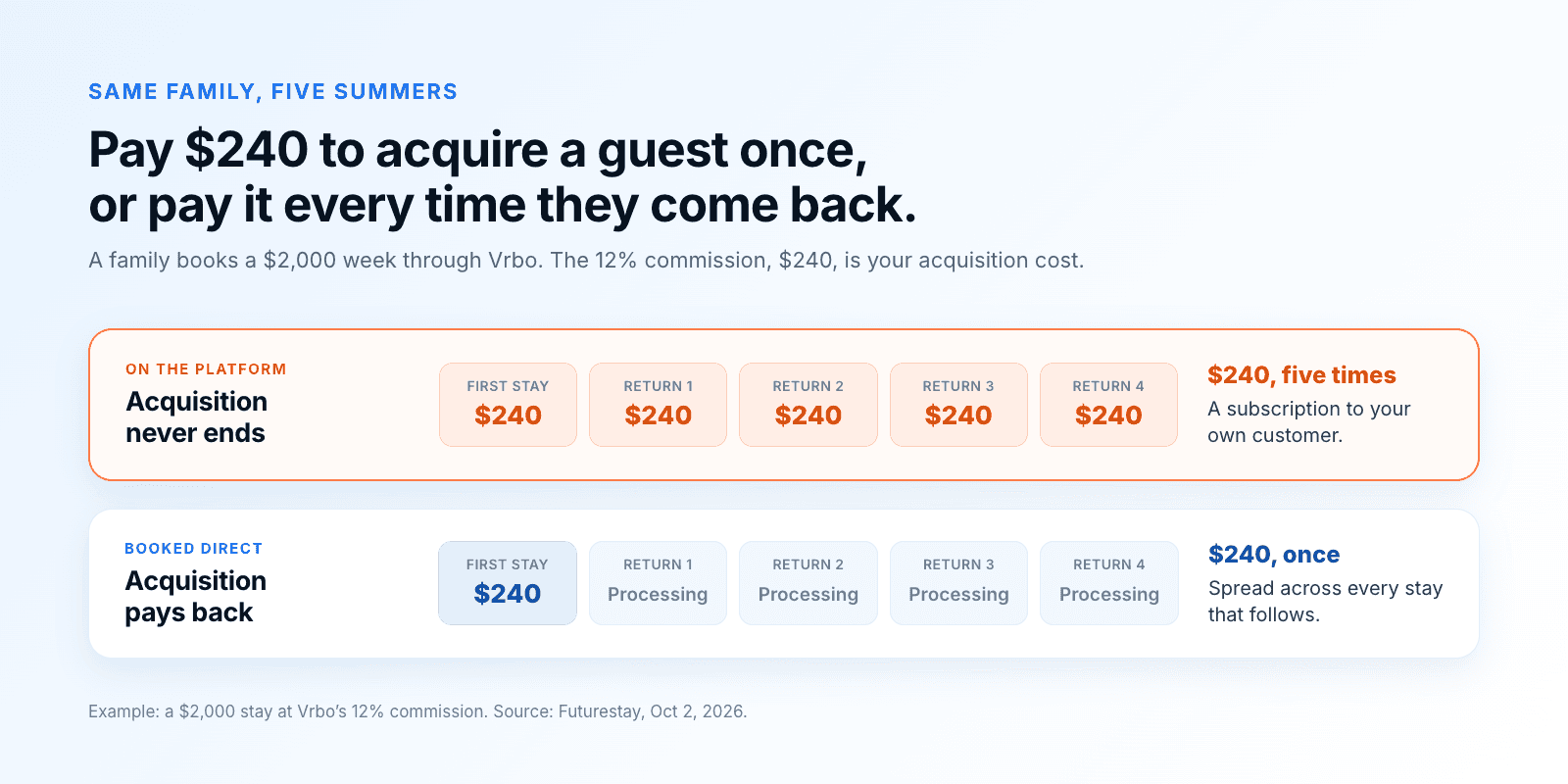
Apply that to a short-term rental. A family books a $2,000 week through Vrbo. The $240 commission is your acquisition cost. If that family never returns, the acquisition paid back once and ended there. If they return the next summer and book directly, the second stay costs you only processing, and your acquisition cost is now spread across two stays. Three, four, five returns, and that original $240 starts to look like one of the best investments you ever made.
But if every return runs back through the platform, the acquisition never ends. You pay $240 the first year and $240 every year after. That isn’t customer acquisition. It’s a subscription to your own customer.
The platforms want you to pay forever
The platforms understand this framing perfectly, which is why they have built their rules to prevent it.
They mask guest contact details so the acquisition never becomes a relationship. They prohibit hosts from steering guests off-platform. Vrbo’s new terms add rate parity, so your own website can’t offer a better price, and a 30-day window that lets Vrbo charge commission on a direct booking that results from a Vrbo inquiry.
The goal of all of it is to turn a one-time acquisition cost into a permanent tax. Not $240 once, but $240 every time that family comes back, for as long as they keep coming.

The guest pays for the acquisition too
The commission is only half of what a platform booking costs. Vrbo also charges travelers a service fee on top of the host’s price, which Skift recently reported at roughly 11% to 14%. Hosts can’t waive it or reduce it.
That fee is part of the cost of acquisition, even though the guest pays it. It makes the stay more expensive for the traveler, and it buys the traveler nothing they didn’t already have the second time around. A family returning to a property they already know isn’t using the platform to discover anything. They are paying a toll to get back to a place they already love.
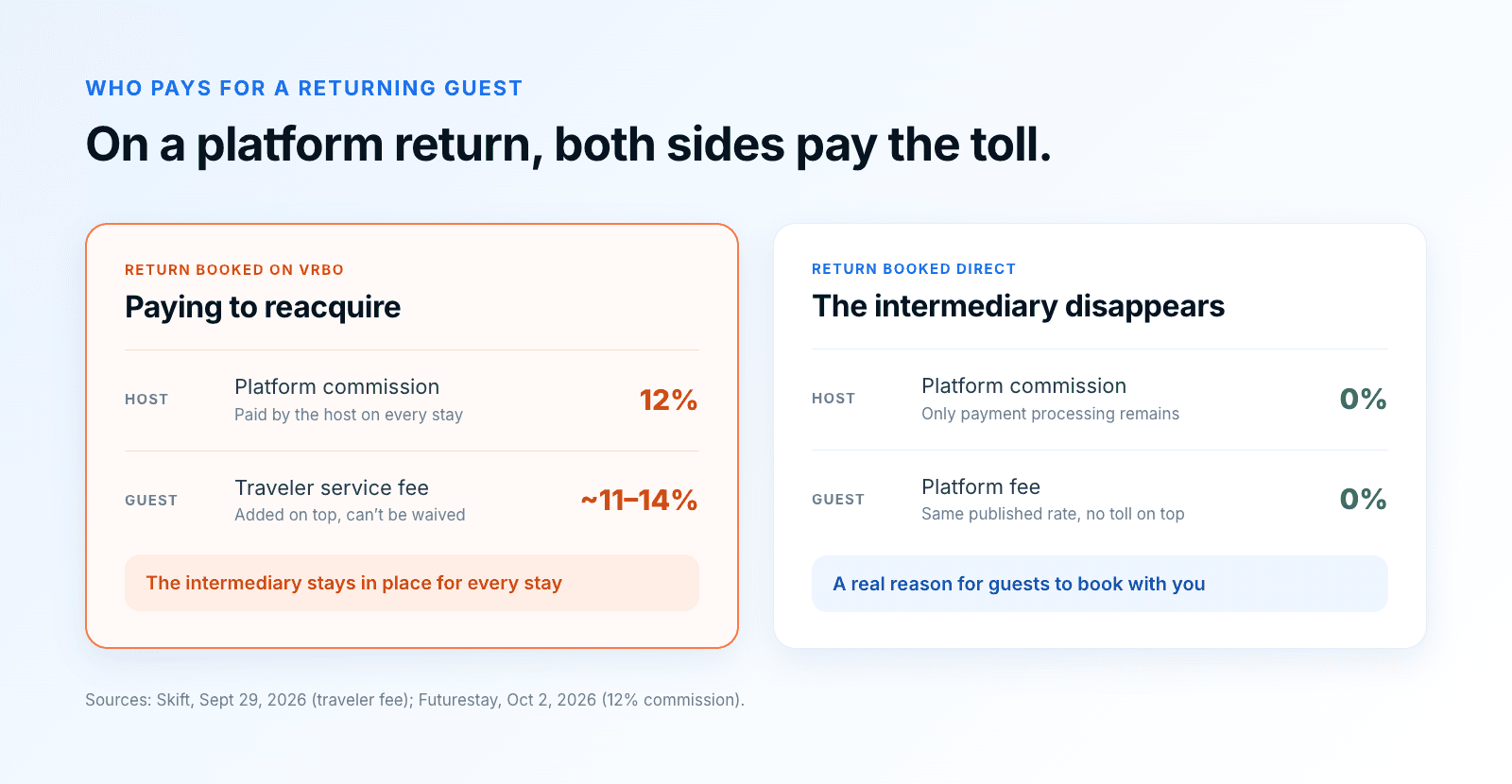
A returning guest who books directly with the host doesn’t pay that platform fee. That is a real reason for guests to prefer booking with you, and it has nothing to do with undercutting your published rate. It is simply the cost of the intermediary disappearing when the intermediary is no longer needed.
The platforms understand this. It is exactly why their rules are designed to keep the intermediary in place for the second stay, the third and every one after.
How acquisition-minded operators run
Accept the first commission. The marketplace introduced a stranger. That is worth paying for, once.
Treat every stay as the start of retention. The goal of a first stay is not a five-star review. It is a second stay that you own.
Build the asset that pays back the acquisition. A guest list, a guest history and a direct way to stay in touch, built from every channel you control.
Give guests a reason to return to you. Loyalty and recognition, not discounts the platforms have already forbidden.
Track payback. Measure what share of each year’s revenue comes from guests you already acquired. That share is your return on every commission you’ve ever paid.
Budget like a marketer
Once commissions are understood as acquisition spend, they belong in the marketing budget, not the cost of goods. That single change in how the numbers are organized changes the decisions that follow.
Set the platform commission next to every other way you could spend money to bring a guest in. Then set it next to what you spend to bring a past guest back. For many operators, the retention line is close to zero, and the commission line is the largest marketing expense in the business.
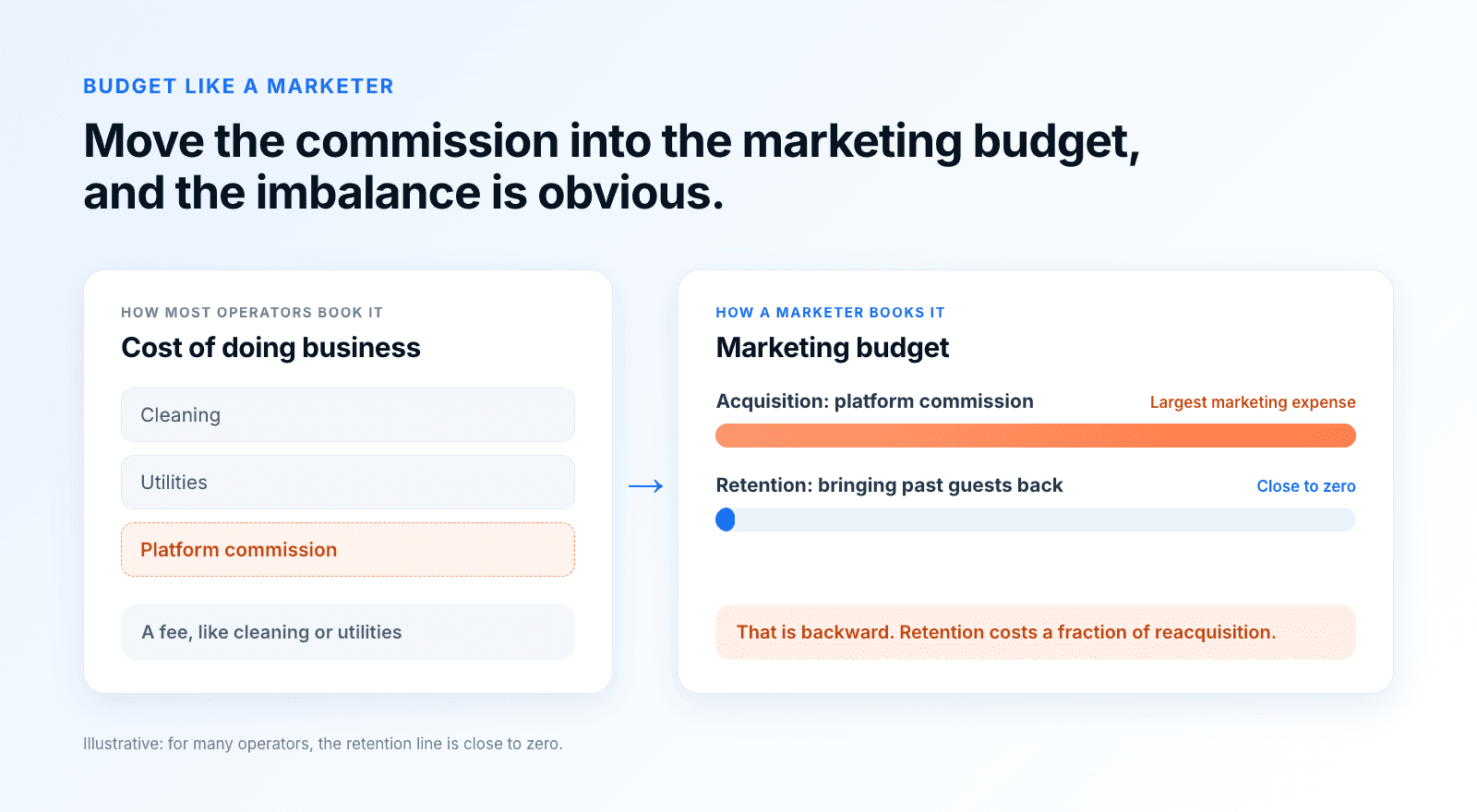
That is backward. A modest, consistent investment in staying connected with past guests — a guest database, regular communication, a loyalty program — costs a fraction of what it costs to reacquire those same guests through a marketplace. Even a small shift of returning stays from platform to direct pays for the retention program many times over.
The operators who run their businesses this way end up with a clear view of every dollar: what they spent to acquire guests, what they spent to keep them, and what each of those guests has been worth over time. That clarity is the foundation for every other decision.
What to stop doing
Stop measuring success only in platform metrics. Ranking, badges and platform reviews matter for acquisition. They say nothing about whether you are building a business you own.
Stop treating the platform inbox as your guest communication system. It belongs to the platform, operates on its rules and disappears when the stay ends.
Stop thinking of returning guests as platform bookings. They are your customers. Every return that runs through a marketplace is a retention failure, not a channel win.
Stop reaching for discounts. Rate parity has closed that door, and discounting was never the strongest reason to return anyway. Recognition, service and a relationship are.
Spend once. Own forever.
The operators who run their businesses on platform terms will keep paying rising commissions on the same guests indefinitely. The operators who treat platforms as an acquisition channel will pay once and build a business on what comes after.

Yada exists for the second group. Guest data, marketing and loyalty that turn every acquired guest into a relationship you own, so the commission you paid becomes an investment instead of a subscription.
See how Yada turns acquired guests into returning ones →