Insights
The Lifetime Value of a Guest You Actually Know
A platform sees four bookings; you see one guest. How to calculate what a returning guest is worth, and why platforms would prefer you never do the math.
Petar Ojdrovic
Yada
·
6 min read

Most short-term rental operators can tell you their occupancy, their ADR and their monthly revenue. Very few can tell you what a single guest is worth over five years. That number is the most important one in the business, and the platforms would prefer you never calculate it.
A booking is not a customer
A platform reports revenue per booking because that is how it gets paid. Every stay is a fresh transaction, and every transaction carries a commission. From the platform’s point of view, a guest who returns four times is four sales.
From the operator’s point of view, that guest is one customer. And the economics of a customer you know are radically different from the economics of a stranger you rent to once.

The math on one guest
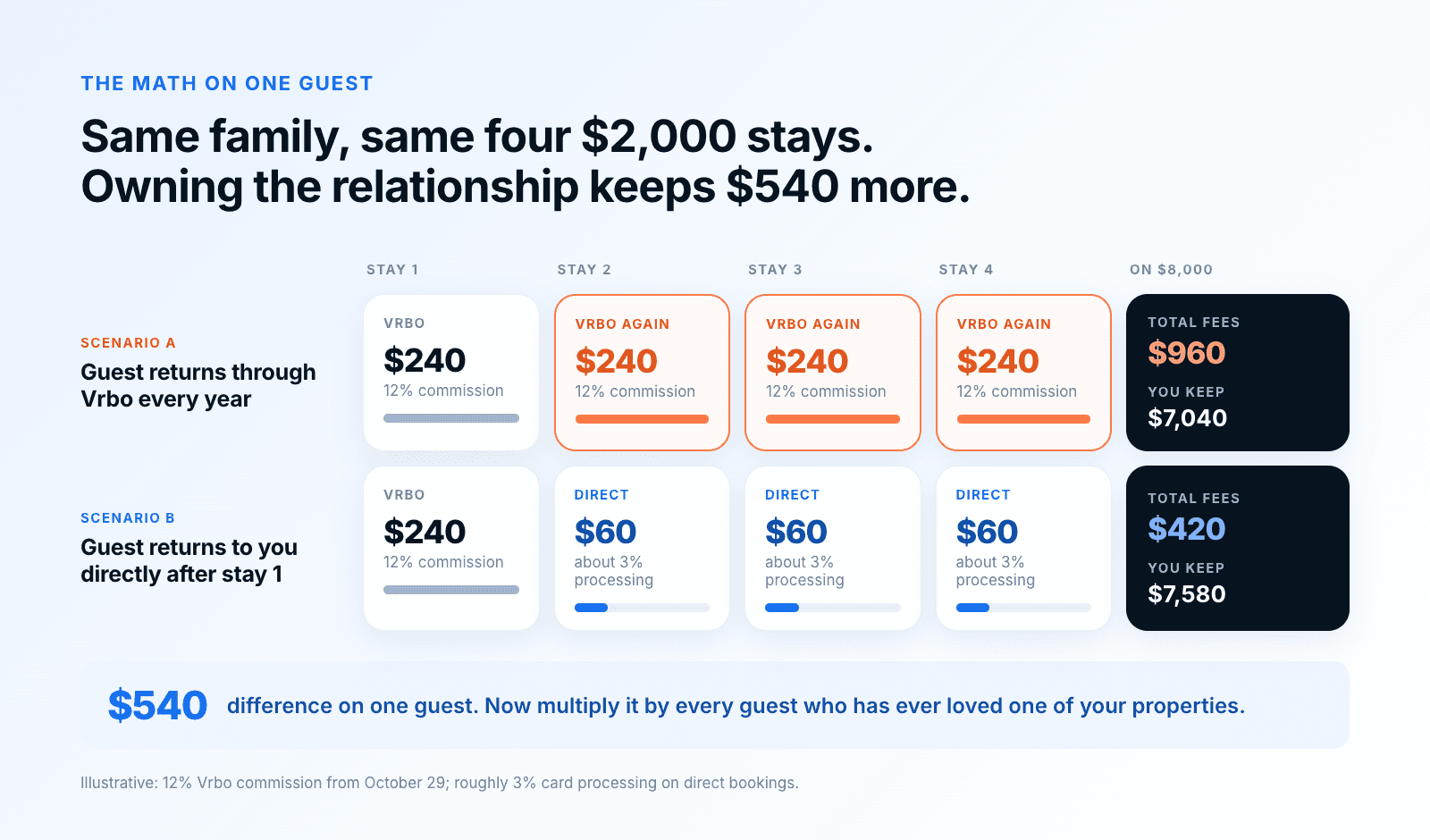
Take a family that books a $2,000 week at your property and loves it enough to come back every summer for the next three years. Four stays, $8,000 in revenue. Here is what that guest costs you in fees, depending on whether you own the relationship.
Scenario | Stay 1 | Stays 2–4 | Total fees on $8,000 | You keep |
|---|---|---|---|---|
Guest returns through Vrbo every year | $240 (12%) | $720 (12% each) | $960 | $7,040 |
Guest returns to you directly after stay 1 | $240 (12%) | $180 (about 3% processing each) | $420 | $7,580 |
One guest. A $540 difference. Now multiply it by every family, every couple and every group that has ever loved one of your properties.
The figures are illustrative: a 12% Vrbo commission from October 29 and roughly 3% card processing on direct bookings. Your own numbers will differ. The shape won’t.
Now scale it to a portfolio
One guest is a rounding error. A portfolio is not.
Take an operator with 20 properties, each hosting about 25 stays a year. That’s 500 stays. Suppose 100 of them come from guests who have stayed with the operator before, and today those returning guests rebook through Vrbo because that’s where they found the property the first time.
At $2,000 a stay, the difference between a 12% platform commission and roughly 3% processing on a direct booking is about $180 per stay. Across 100 returning stays, that’s $18,000 a year. Over five years, $90,000, paid to a platform to rebook guests the operator had already won.
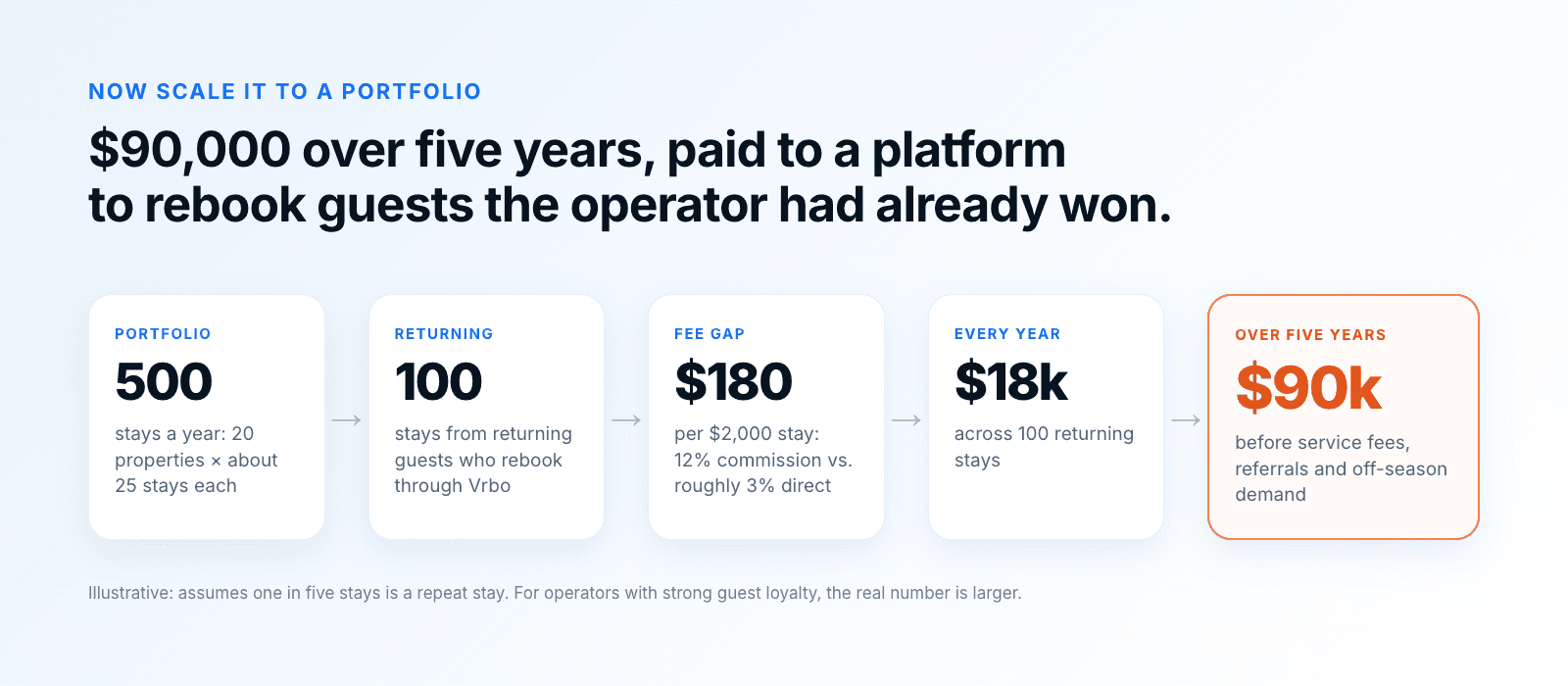
That figure doesn’t include the guest service fee those travelers pay on top, which makes the platform booking more expensive for the guest as well. It doesn’t include referrals, off-season demand or the value of a guest base that can be reached with an email. And it only assumes that a fifth of stays are repeat stays. For operators with strong guest loyalty, the real number is larger.
What the table leaves out
The fee savings understate the real value of a guest you know.

Referrals. A guest who loves you tells friends. A guest who books through a marketplace sends those friends back to the marketplace.
Off-season demand. A guest list lets you fill shoulder weeks with a single email. A platform makes you compete for them in search.
Pricing power. A returning guest is booking you, not comparing you. That is a fundamentally better position than appearing in a grid of thirty listings.
Resilience. When a platform raises fees, changes ranking or rewrites its terms, the share of your revenue that comes from known guests is the share that doesn’t move.
How to calculate it for your business
Guest lifetime value sounds like a finance exercise. It’s not complicated, and every operator should be able to do it on the back of an envelope.

Average stay value. Total revenue divided by number of stays over the past year.
Repeat rate. The share of guests who have stayed with you more than once. If you can’t measure this today, that is itself the most important finding.
Stays per returning guest. Over a multi-year window, how many times does a returning guest book with you on average?
Cost per stay by channel. The commission and fees you pay on a platform booking versus the processing and marketing cost of a direct one.
Lifetime value. Multiply average stay value by expected stays per guest, then subtract the channel cost of each stay.
Run it twice: once assuming returning guests rebook through a platform, and once assuming they rebook with you. The gap between those two numbers is what owning the relationship is worth, per guest. Multiply by the number of guests you host each year, and you have the size of the opportunity.
The exercise forces two questions every operator should be able to answer: how many of your guests come back, and how many of those you actually own.
Why the platforms don’t want you doing this math
If operators measured guest lifetime value, they would immediately see the platforms for what they are: an expensive way to acquire a guest once, and an absurd way to rent that same guest back year after year.
That is why the platforms mask contact details, ban hosts from steering guests off-platform, and — in Vrbo’s case — now claim commission on direct bookings that follow a Vrbo inquiry within 30 days. Every one of those rules exists to keep the second, third and fourth stay inside the platform’s checkout.
What moves the number
Guest lifetime value is not fixed. It responds to four levers, and operators control all of them.
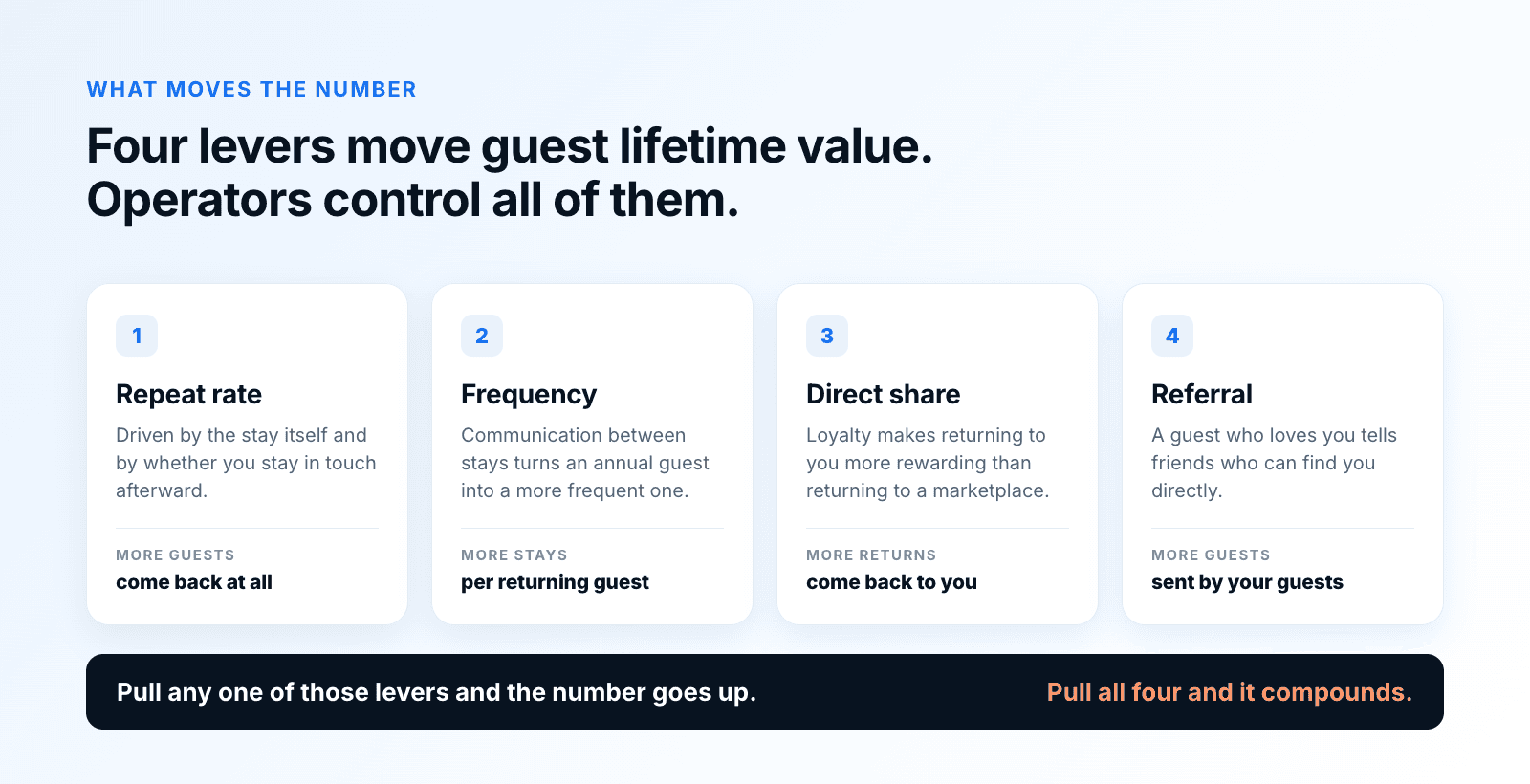
Repeat rate. Driven by the stay itself and by whether you stay in touch afterward. A guest who had a wonderful week but never hears from you again is a guest you are leaving to chance.
Frequency. Returning guests who come back every year are valuable. Returning guests who also discover your fall weekends or your second property are more valuable. Communication between stays is what turns an annual guest into a more frequent one.
Direct share. The portion of returning stays that come back to you rather than through a platform. This is where loyalty earns its keep: recognition and benefits that make returning to you more rewarding than returning to a marketplace.
Referral. A guest who loves you tells friends. When those friends can find you directly, your lifetime value includes the guests your guests send.
Pull any one of those levers and the number goes up. Pull all four and it compounds.
Start measuring the right number
The operators who win the next decade will track three things alongside occupancy: repeat guest rate, direct share of repeat bookings, and revenue per guest over time. Those metrics tell you whether you are building a business or renting one.
Set your baseline this quarter
The first step is not a new tool or a new campaign. It is a number. Before the end of this quarter, every operator should know:
How many unique guests they hosted in the past twelve months
What share of those guests had stayed before
What share of returning guests booked directly versus through a platform
What they paid in platform commissions on returning guests
Write those four numbers down. They are your baseline. Every improvement from here — a higher repeat rate, a higher direct share, a lower commission bill on guests you already know — shows up directly in the business.
Vrbo’s move to a 12% commission and its new 30-day claim on direct bookings that follow a Vrbo inquiry make this more urgent, not less. The platforms are raising the price of renting your own guests back to you. The operators who measure guest lifetime value will be the ones who stop paying it.
Yada is built to move all three. Guest data you own, marketing that brings past guests back, and loyalty that gives them a reason to return to you instead of a marketplace.