Insights
Your Reviews Belong to You. The Platforms Disagree.
Hosts earn every five-star review, but the platforms own them. That locked-in reputation keeps hosts paying rising fees. Here's how to build one you own.
Petar Ojdrovic
Yada
·
6 min read

A host with 400 five-star reviews has built one of the most valuable assets in hospitality: proof, at scale, that guests trust them. Then ask a simple question. Where does that asset live? Not with the host. It lives on Airbnb’s servers, attached to Airbnb’s listing page, governed by Airbnb’s rules. The same is true on Vrbo. Operators spend years building reputations they cannot export, cannot own, and cannot take with them.
Reputation is the host’s work product
Every review on a platform is the output of the host’s labor. The clean linens, the fast reply, the thoughtful welcome, the problem solved at midnight. The platform contributed a form field.
Yet the moment that reputation is written down, it becomes platform property in every way that matters. It ranks the listing in the platform’s search. It persuades the platform’s travelers. It increases the platform’s conversion rate. And it stays put if the host ever decides to leave.
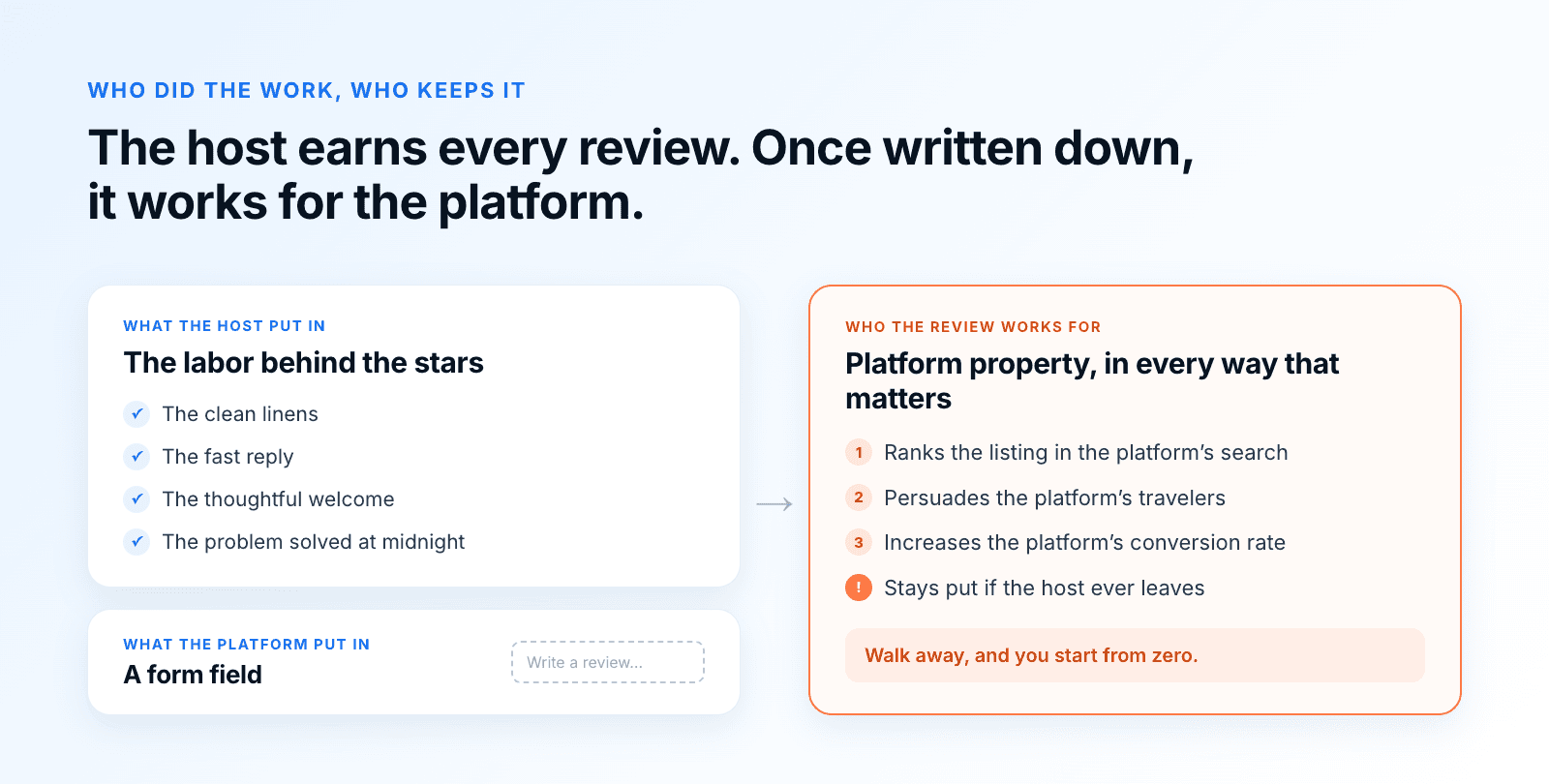
That is not an accident of product design. It is a moat. A host with years of reviews on one platform faces an enormous switching cost: walk away, and you start from zero. The reviews that should make a host independent are exactly what keep them dependent.
Why reviews matter more in short-term rentals than anywhere else
A hotel guest is buying a known quantity. A Marriott in Denver and a Marriott in Atlanta share brand standards, a loyalty program and a reasonable expectation of what the room will look like. The brand does a large share of the persuading.
A short-term rental guest has none of that. Every property is different. Every host is different. The guest is booking a stranger’s home, often for a family trip they have been planning for months, and they are trusting photos and a description written by the person who wants their money. Reviews are what close that gap. They are the evidence that the hot tub works, the beds are comfortable, the host answers at midnight, and the neighborhood is what the listing says it is.

That makes reviews the single most powerful marketing asset an operator has. They do more to convert a hesitant guest than any photo, any description, any discount. Operators know this, which is why they work so hard for every five-star rating.
The problem is not that reviews matter. The problem is who they belong to.
Locked-in reputation means locked-in hosts
Think about how this compounds. A new operator lists on a platform because that’s where the travelers are. Reviews accumulate. Ranking improves. The listing becomes more valuable on that platform and nowhere else. Fees rise. Policies tighten. The operator considers alternatives and realizes their entire track record is non-transferable.

This is the same dynamic the platforms apply to guest contact information. Hide the guest, keep the reviews, and the host’s two most important assets — who their customers are and what those customers think of them — never leave the building.
The asymmetry
Platforms do not just hold the reviews. They make every rule about them.
They decide how reviews are collected, displayed and weighted. They decide which reviews are removed and which stay up. They decide how much a single bad review affects a listing’s ranking. When a host believes a review is unfair, the only appeal is to the platform that owns it, under a policy the platform wrote and can change.
The host has no independent record of their own reputation. They cannot export it, cannot display it elsewhere in any meaningful way, and cannot carry it to a new channel. Years of work exist only as rows in someone else’s database.
That asymmetry would be tolerable if the platform’s interests and the host’s interests were aligned. They increasingly are not. The platform wants the host to stay, to accept its fees, and to keep guests inside its checkout. Locked-in reviews serve all three goals.
What happens when you try to leave
Consider an operator who has spent five years on a single platform. Hundreds of reviews. A strong ranking. A track record any guest can see.
Now the platform raises its fees. Vrbo, for example, is moving every host to a flat 12% commission on October 29, up from roughly 8% for most hosts. The operator runs the numbers and considers shifting more of their business elsewhere.
Then they confront the real cost. A new listing on a different platform starts with zero reviews. Guests skip listings without reviews. The ranking algorithm buries them. Months of discounted rates may be needed just to rebuild a fraction of the trust the operator already earned. So the operator stays and pays the higher fee.
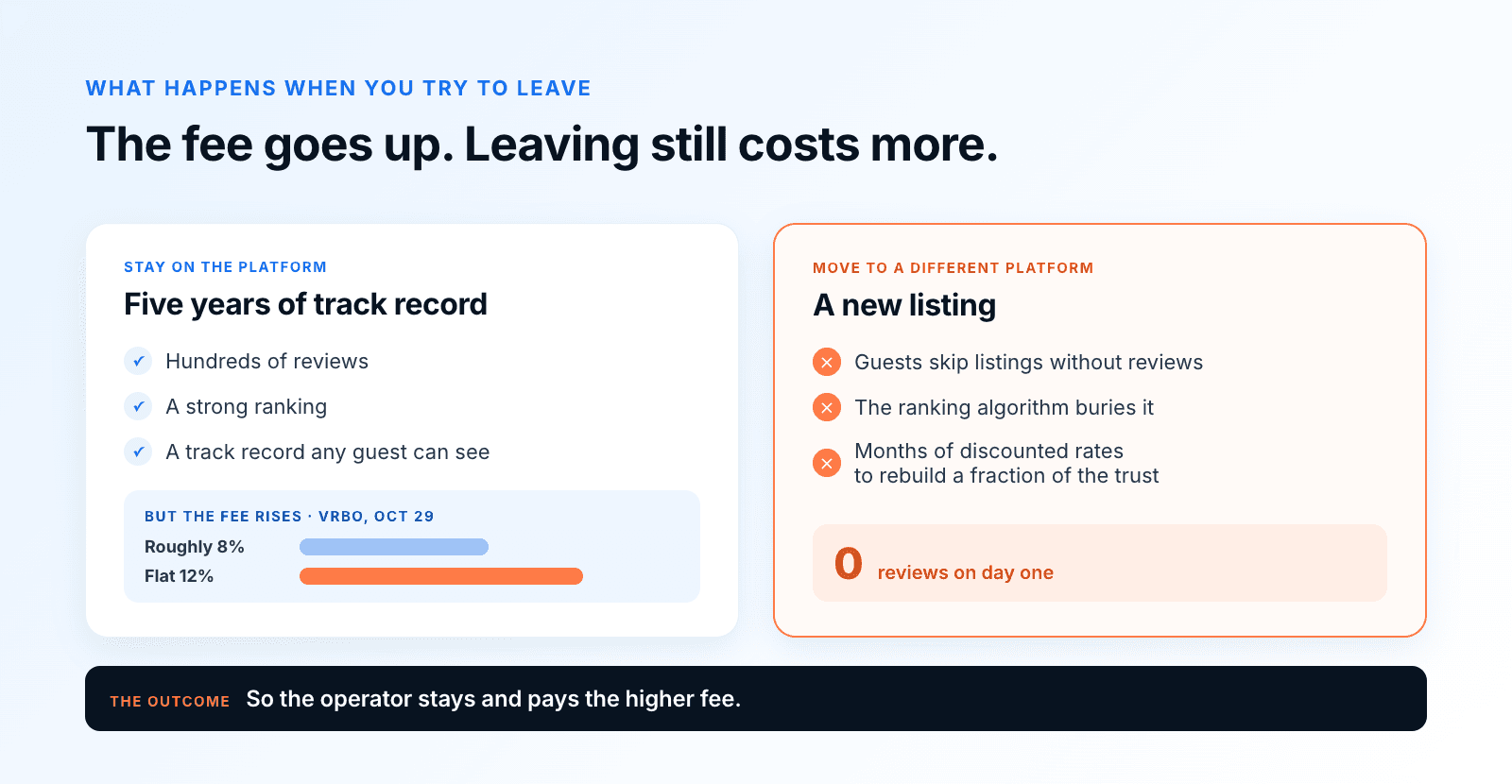
That is the outcome locked-in reputation is designed to produce. The reviews that should give an operator leverage end up removing it.
Build a reputation you own
Operators cannot force a platform to release its reviews. They can stop letting a platform be the only place their reputation exists.

Collect feedback directly. Every guest who books direct should hear from you after their stay, and their response should land in a system you control.
Publish it on your own site. Testimonials on your website are yours. They persuade the guests most likely to book direct, and no platform can delist them.
Earn reviews on open channels. Google reviews tied to your business are visible in search and travel with your brand, not a listing ID.
Treat guest sentiment as data. What returning guests love, what first-timers complain about, which properties earn the warmest feedback. That insight belongs in your guest profile, not just a star rating on someone else’s page.
Feedback is the start of a relationship, not the end of a stay
On a platform, a review is the last interaction. The guest leaves, writes a few sentences, and disappears into the platform’s ecosystem. The host never hears from them again unless the platform decides to show them the listing a second time.

Operators who own their guest relationships treat feedback differently. It is the first step toward the next stay.
Ask what they loved, specifically. The guest who mentions the sunset from the deck is telling you how to invite them back next summer.
Close the loop privately when something went wrong. A guest who had an issue and heard from you directly is far more likely to return than one whose only outlet was a public review.
Record preferences. The family that needed a crib, the couple celebrating an anniversary, the group that wants a late checkout. That history makes the next stay better and makes a direct relationship more valuable than any listing.
Invite them back. Feedback collected on your channels gives you permission and a reason to stay in touch.
A platform review is a score. Direct feedback is a conversation. Only one of them builds a business.
Questions every operator should be able to answer
If you want to know how exposed your reputation is, ask yourself:
If a platform removed your listing tomorrow, what proof of your track record would remain?
How many of your past guests could you contact today, without going through a platform?
Where does a guest find testimonials about you outside a marketplace?
Do you know which of your guests loved their stay enough to come back?
If the honest answers are “very little,” “almost none,” “nowhere” and “no,” your reputation is not an asset. It is a liability you are renting.
Yada gives operators a guest data platform they own, so every stay, preference, and relationship lives with the host and powers their own marketing. Your reputation is the most persuasive thing you have. It should work for you.
See how Yada helps operators own their guest relationships →