Insights
Every Platform Ends Up a Landlord
Every marketplace starts as a partner and ends as a landlord. Airbnb and Vrbo's new fees follow the pattern. Here's how operators can own their guests instead.
Petar Ojdrovic
Yada
·
6 min read

Every marketplace begins as a partner and ends as a landlord. Short-term rental operators are watching that transition happen in real time, and the past month made it impossible to ignore.
The pattern
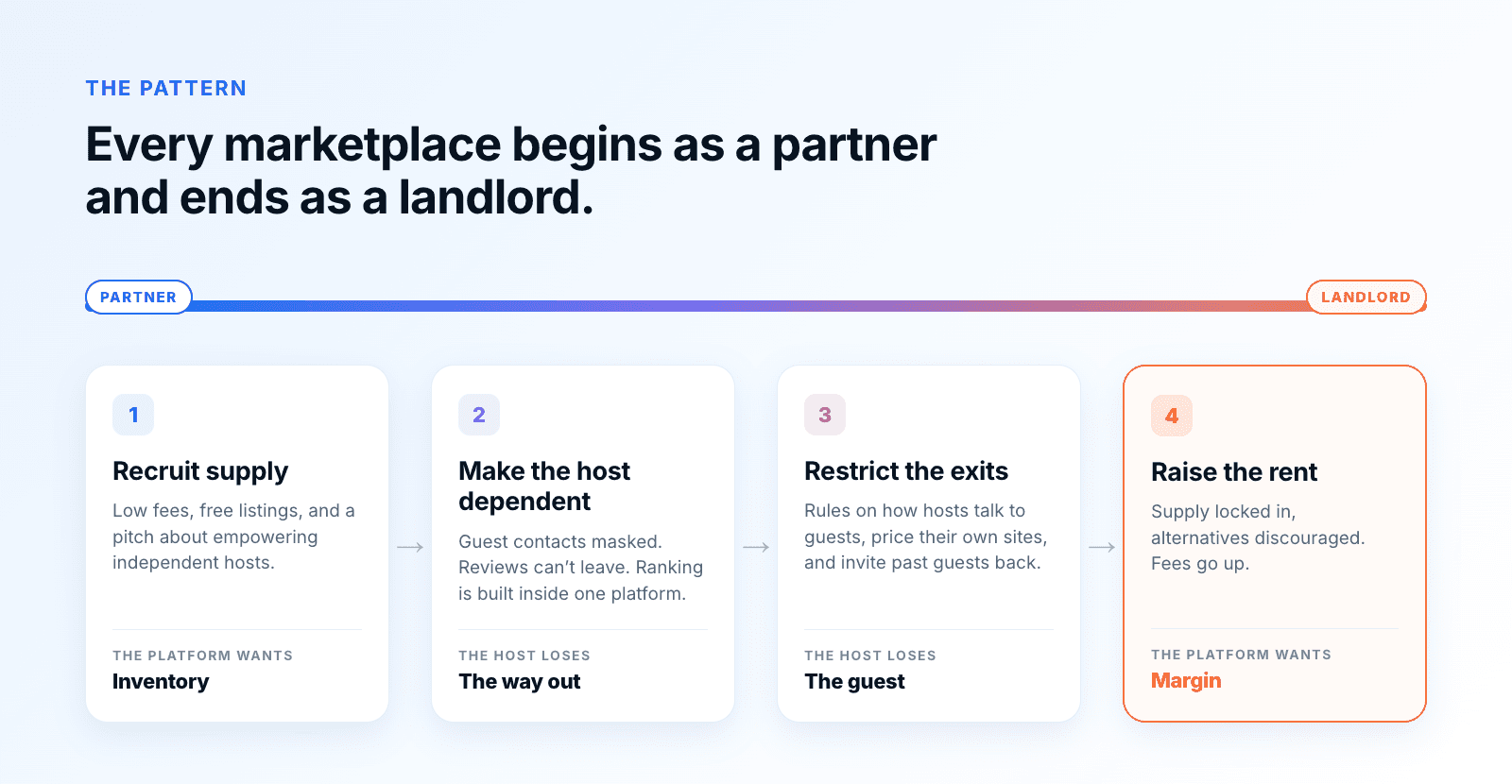
The arc is predictable, because it serves the platform at every stage.
Recruit supply with generous terms. Low fees, free listings, and a pitch about empowering independent hosts. The platform needs inventory, and it pays for it with favorable economics.
Make the host dependent. Guest contact details are masked. Reviews live on the listing and can’t leave. Search ranking is built on performance inside that one platform. Every year on the platform raises the cost of walking away.
Restrict the exits. Rules appear that limit how hosts talk to guests, how they price their own websites, and whether they can invite a past guest back directly.
Raise the rent. With supply locked in and alternatives discouraged, fees go up, and the host has fewer options than when they arrived.
None of this requires bad intent at any single step. It only requires a business model in which the platform’s growth depends on owning the customer, and the host’s independence is a threat to it.
We have seen this movie before
Short-term rentals are not the first industry to discover that a platform built on its supply would eventually turn on it.
App developers spent years under app store rules that took a large cut of digital sales and prohibited developers from even telling customers that a cheaper option existed elsewhere. It took litigation and regulators on several continents to start loosening those anti-steering rules.
Restaurants embraced delivery apps for the reach, then watched commissions take so much of each order that several U.S. cities, New York among them, stepped in to cap the fees.
Third-party sellers on large e-commerce marketplaces have described the same arc for years: fees that climb, advertising that becomes mandatory to stay visible, and a customer relationship that belongs to the marketplace, not the merchant.
The details differ. The structure is identical. Supply arrives because the platform has demand. The platform restricts supply’s access to that demand. Then it charges more for the access it controls.
Where we are now
Look at the last few weeks.
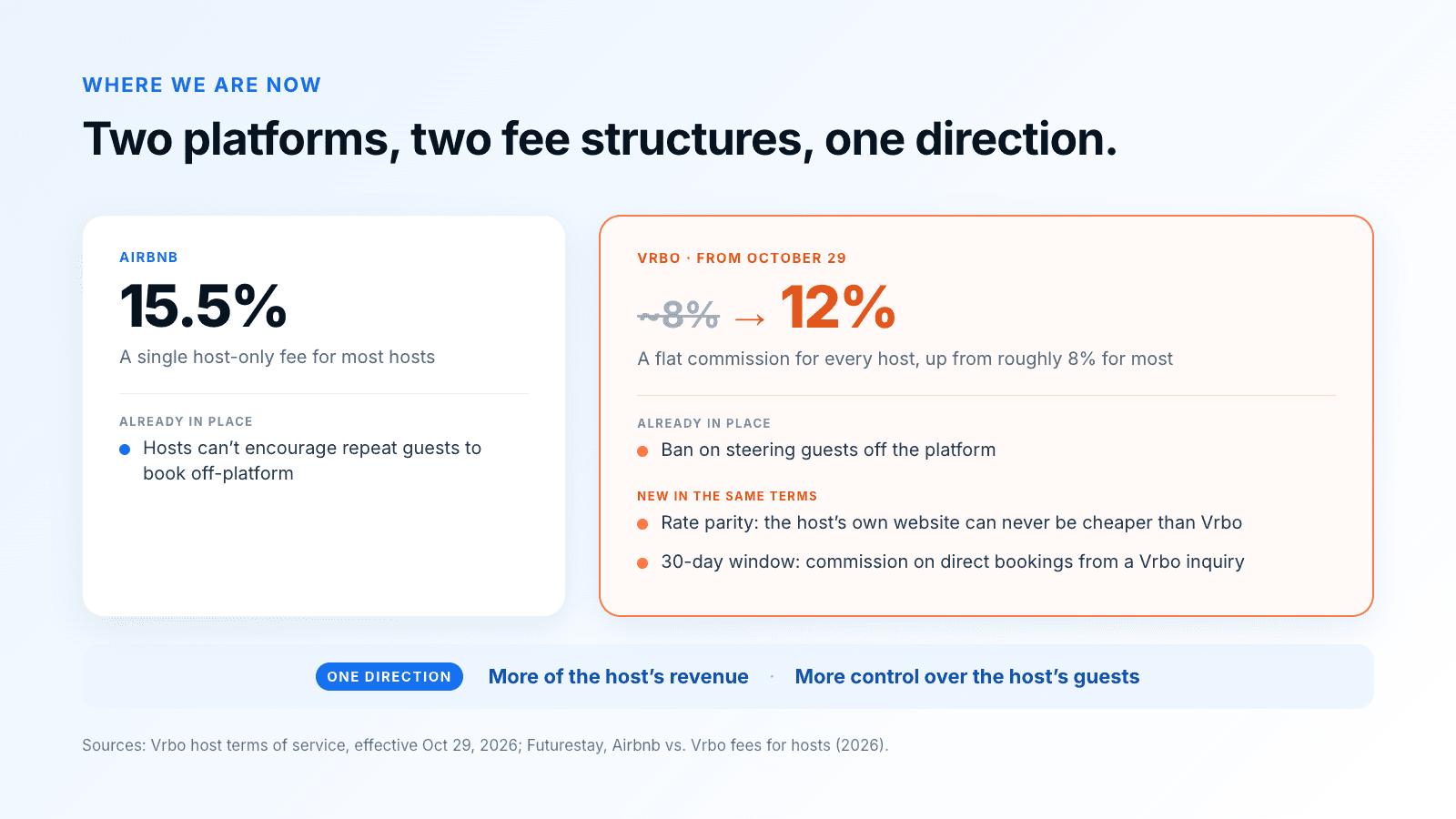
Airbnb has moved most hosts to a single 15.5% host-only fee, and it already prohibits hosts from encouraging repeat guests to book off-platform.
Vrbo announced on September 29 that every host moves to a flat 12% commission on October 29 — up from roughly 8% for most hosts. The same terms add rate parity, so a host’s own website can never be cheaper than Vrbo, and a new 30-day window that lets Vrbo charge commission on a direct booking that results from a Vrbo inquiry. All of it sits on top of an existing ban on steering guests off the platform.
Two platforms, two different fee structures, one direction: more of the host’s revenue, more control over the host’s guests.
Why the squeeze always comes
It is tempting to read each fee increase as a one-off decision. It isn’t. The squeeze is built into the economics.
In the growth years, a platform’s priority is inventory. It needs hosts more than hosts need it, so the terms are generous. Once the platform has the inventory, the priority shifts to margin. Growth slows, public-market investors want profitability, and the obvious source of profit is the side of the marketplace with the least bargaining power.
In short-term rentals, that side is the host. Guests can compare platforms freely and are courted with promotions. Hosts are fragmented: hundreds of thousands of individual owners and small management companies, none large enough to negotiate. Vrbo sits inside Expedia Group. Airbnb is a public company. On the other side of the table is an operator with a handful of properties and a listing they can’t afford to lose.

That imbalance is why the terms only ever move in one direction.
A landlord, not a partner
A partner is paid for the value it creates. A landlord is paid because you have nowhere else to go.
The platforms still create value. They introduce travelers to properties, and that is worth paying for. But each new rule shifts the relationship further from paying for introductions and closer to paying rent on access to your own guests. The platforms are not asking hosts to accept a higher price for a better service. They are asking hosts to accept that the guest belongs to the platform, and that the host is a tenant.
What every landlord counts on
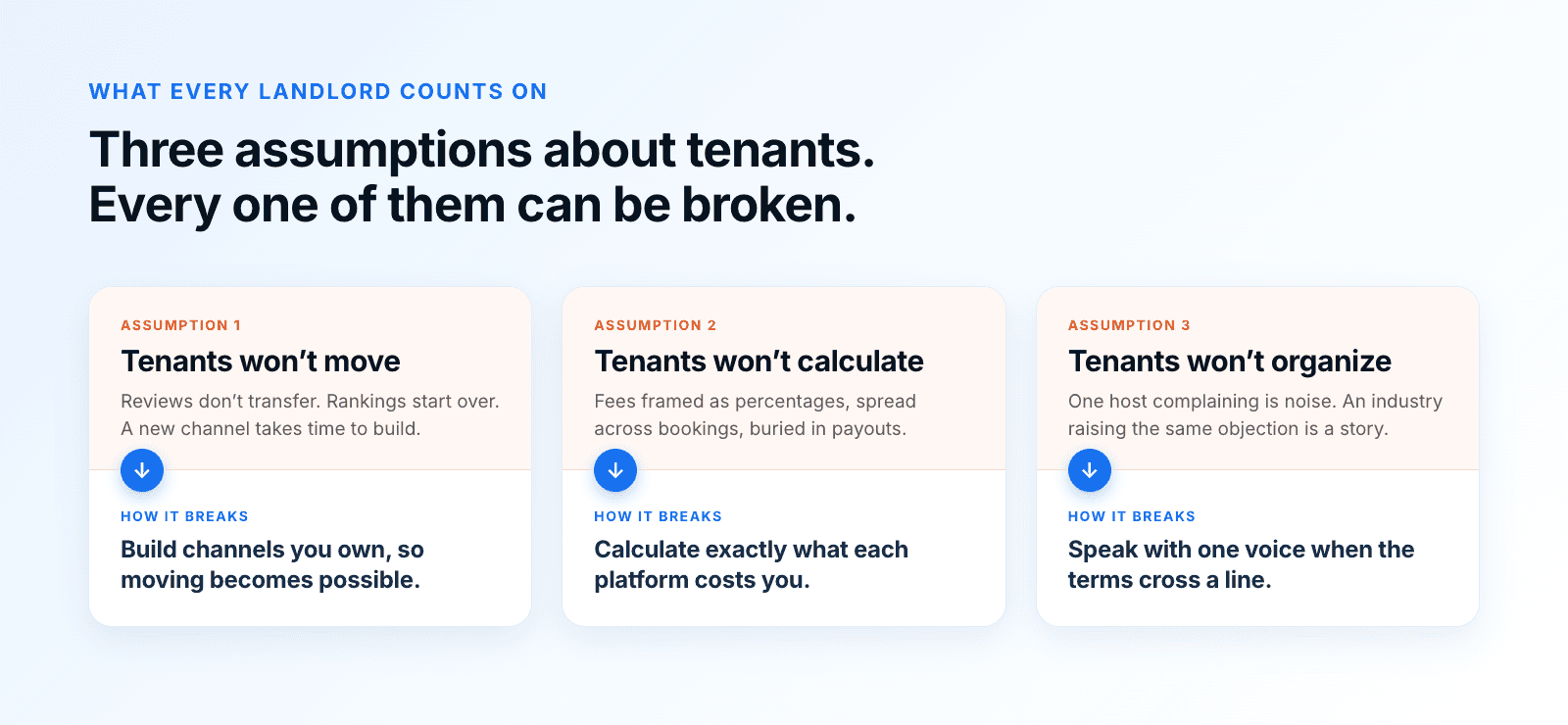
A landlord’s business model rests on three assumptions about tenants.
Tenants won’t move. Switching costs are high. Reviews don’t transfer. Rankings start over. A new channel takes time to build. Every month spent on a single platform raises the cost of leaving it.
Tenants won’t calculate. Fees are framed as percentages, spread across bookings, and buried in payouts. Few operators add up what they paid a platform last year, let alone what they paid to rebook guests who had already stayed with them.
Tenants won’t organize. A single host complaining about terms is noise. An industry raising the same objection is a story.
Every one of those assumptions can be broken. Operators can build channels they own so moving becomes possible. They can calculate exactly what each platform costs them. And they can speak with one voice when the terms cross a line, as Vrbo’s new 30-day clause plainly does.
Own the building
The answer is not to abandon the marketplaces overnight. It is to stop building your entire business on land you don’t own.

Treat every platform as a channel, not a home. Use it to acquire guests. Never let it be the only way those guests can reach you.
Own the guest relationship. Build a guest list, a guest history, and a direct line of communication that no platform’s terms can revoke.
Give guests a reason to come back to you. Loyalty and recognition, not price cuts the platform has already forbidden.
Measure your dependency. Track the share of revenue from repeat and direct guests. Every point it rises is a point of rent you no longer pay.
A 12-month plan to reduce dependency
Independence is not a switch. It is a year of deliberate work. Here is how an operator can approach it.

Months 1–3: Know your exposure. Calculate what each platform cost you over the past twelve months, including commissions on returning guests. Measure your repeat guest rate and the share of revenue that came through channels you own. Those numbers are your baseline.
Months 4–6: Build the guest base. Make sure every direct booking, every website inquiry and every guest who opts in lands in a single guest database you control. Start staying in touch after every stay you own.
Months 7–9: Give guests a reason to return. Launch a loyalty program or returning-guest benefits. Give past guests early notice when peak dates and seasonal openings become available, so they hear it from you first.
Months 10–12: Measure and reinvest. Compare your direct share and repeat rate to your baseline. Every point of improvement is commission you no longer pay. Reinvest part of it in the guest experience that drives the next return.
At the end of a year, the platforms are still there, still useful for finding new guests. The difference is that they no longer own the ones you already have.
Shopify understood this about e-commerce a decade ago: merchants needed tools to build businesses they owned, not storefronts inside someone else’s mall. Hospitality operators need the same thing. That is why we built Yada — a guest data platform, marketing, and loyalty that give operators the infrastructure to own their guest relationships.
The platforms have decided what they want to be. Operators should decide what they want to be, too.
See how Yada helps operators build a business they own →