Insights
What Hotels Figured Out Ten Years Ago
In 2016 hotels beat the OTAs by owning the guest relationship. Short-term rental operators now face the same fight, and the hotel playbook still works.
Petar Ojdrovic
Yada
·
5 min read

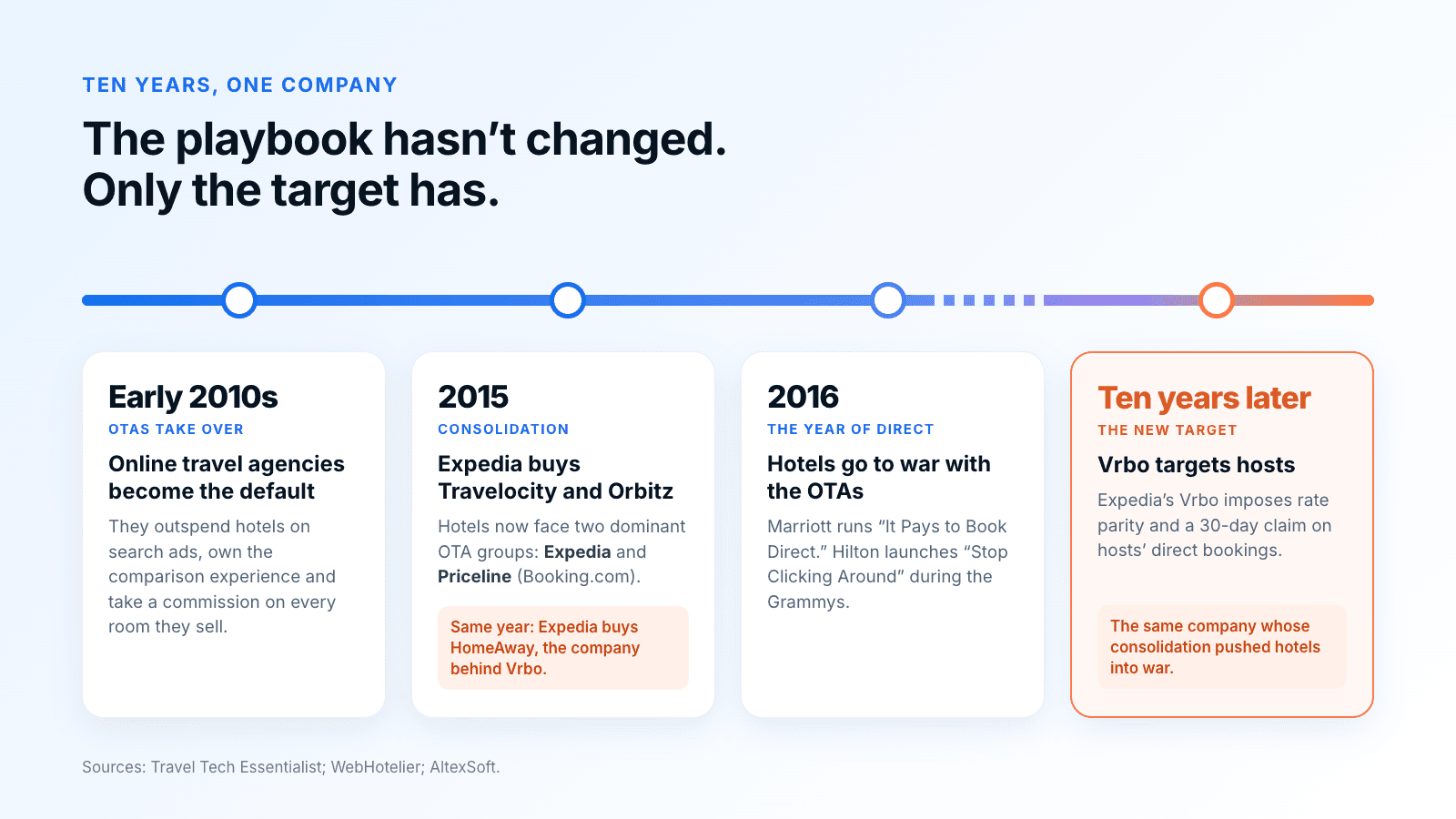
In 2016, the largest hotel companies in the world went to war with the online travel agencies. Marriott ran “It Pays to Book Direct.” Hilton launched “Stop Clicking Around” during the Grammys, the biggest marketing campaign in its history. Hyatt, Choice and Wyndham followed with their own direct-booking incentives. The industry press called it the year of direct.
Ten years later, short-term rental operators are standing exactly where the hotels stood: dependent on intermediaries, watching commissions rise, and losing control of their own guests. The hotels have already shown how this ends. The question is whether operators will learn the lesson or relearn it.
How the hotels got there
The war of 2016 didn’t come out of nowhere. Through the early 2010s, online travel agencies had become the default way millions of travelers searched for and booked hotels. They outspent hotels on search advertising, owned the comparison experience, and collected substantial commissions on every room they sold.
Then the industry consolidated. In 2015 alone, Expedia acquired Travelocity and Orbitz, leaving hotels facing two dominant OTA groups: Expedia on one side and the Priceline Group, owner of Booking.com, on the other. That same year, Expedia acquired HomeAway, the company behind Vrbo.
That detail is worth sitting with. The company whose consolidation pushed the hotel industry into its direct-booking war is the same company that owns the short-term rental platform now imposing rate parity and a 30-day claim on hosts’ direct bookings. The playbook hasn’t changed. Only the target has.
Facing two consolidated intermediaries with growing leverage, the big chains concluded that negotiating harder wasn’t enough. They needed a relationship with the guest that the OTAs couldn’t touch.
What the hotels understood
The hotel chains didn’t win by abandoning the OTAs. They still use them. They won by changing what the OTAs controlled.
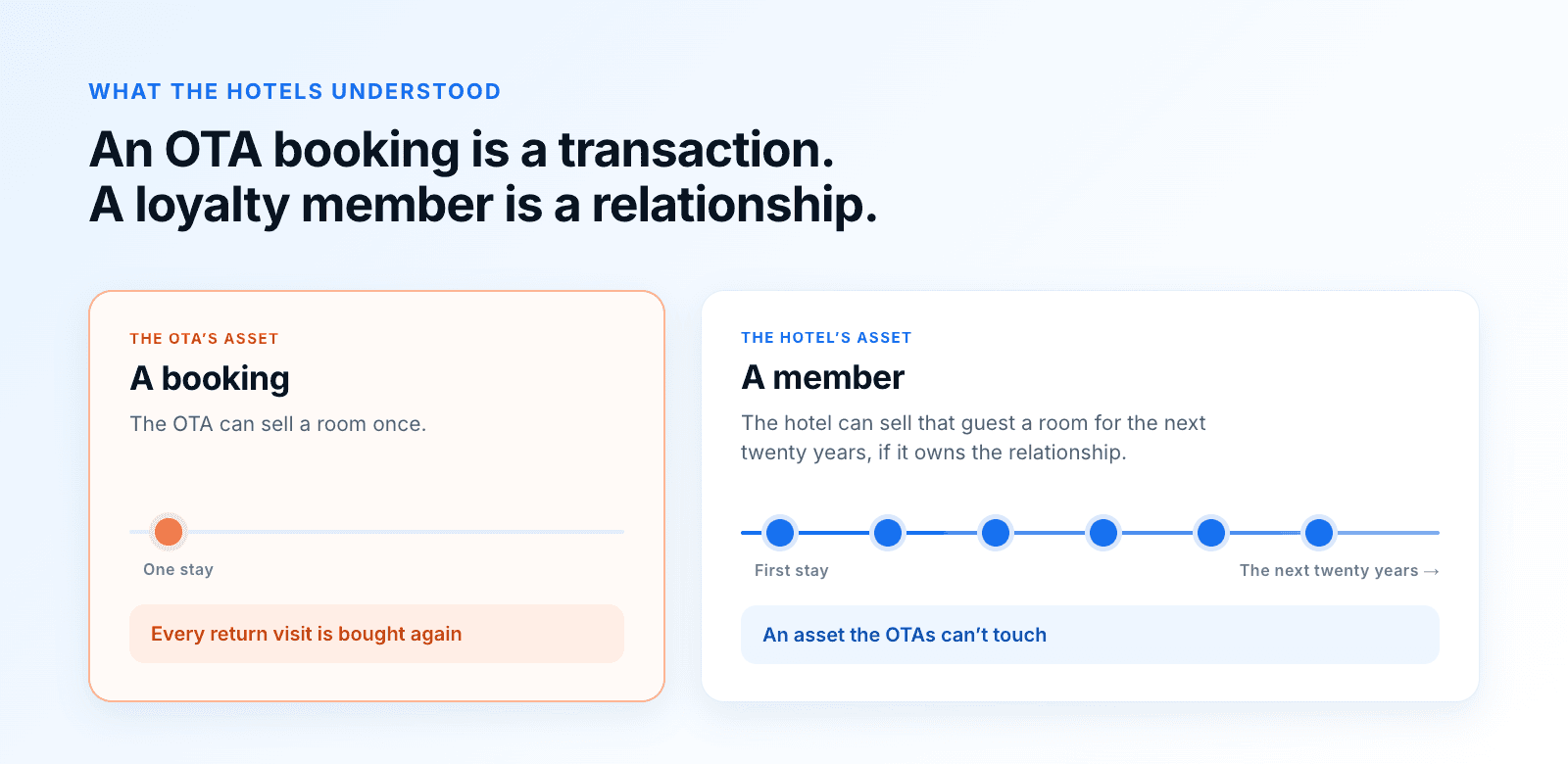
The insight was simple: an OTA booking is a transaction, but a loyalty member is a relationship. The OTA can sell a room once. The hotel can sell that guest a room for the next twenty years, if it owns the relationship. So the chains stopped competing on the OTA’s terms and started building an asset the OTAs could never touch.
The playbook
Make membership the front door. Hilton and Marriott pushed travelers to join their loyalty programs before booking. Membership turned an anonymous traveler into a known guest with a profile, a history and a reason to return.
Give members something the OTA can’t. Member rates, free Wi-Fi, digital keys, points, upgrades. The benefits lived inside the brand’s own channel, so the best experience was only available direct.
Talk to the guest directly. Email, app, account. Once the hotel owned the contact, it no longer needed to buy the same guest back from an intermediary.
Say the quiet part out loud. “Stop Clicking Around” didn’t just advertise rates. It told travelers, in public, that the intermediary was the worse deal.
The OTAs pushed back, and the hotels held
The intermediaries did not take the direct-booking campaigns quietly. Hotels reported losing visibility in OTA search results after pushing direct, a practice the industry nicknamed “dimming.” Commission negotiations got harder. Some in the industry predicted the chains would blink.
They didn’t, because they had something to fall back on. A hotel with millions of loyalty members can absorb a drop in OTA visibility, because a meaningful share of its demand no longer depends on any intermediary’s search ranking. Every member who booked direct was a booking the OTA couldn’t throttle.
That is the lesson within the lesson. Owning the guest relationship isn’t just cheaper. It is leverage. It changes the negotiation from “we need you” to “we’d like to work with you,” and intermediaries treat partners in those two positions very differently.
Why short-term rentals are behind
Hotels had brands, budgets and loyalty programs with tens of millions of members. Most short-term rental operators have none of that, and the platforms have used the gap.

Airbnb and Vrbo mask guest contact details, restrict hosts from steering guests off-platform, and in Vrbo’s case now impose rate parity and a 30-day claim on direct bookings that follow a Vrbo inquiry. The hotels fought to own the guest relationship. The STR platforms have designed their products so operators never get one to begin with.
That makes the hotel lesson more urgent for operators, not less.
Independent hotels proved it scales down
It would be easy to dismiss the hotel story as something only billion-dollar brands can do. Independent and boutique hotels prove otherwise.

The best independents never had a global loyalty program or a Grammys ad budget. What they had was a relationship with their guests. They collected guest information on every direct booking. They stayed in touch between stays with seasonal news and early notice of events. They recognized returning guests by name. They built a small, loyal base that came back year after year and sent friends.
Those properties still use OTAs to find new guests. But their returning guests come back to them. That is exactly the model short-term rental operators need, and it requires infrastructure, not scale.
The same playbook, built for operators
You do not need a billion-dollar ad campaign to do what the hotels did. You need the infrastructure.
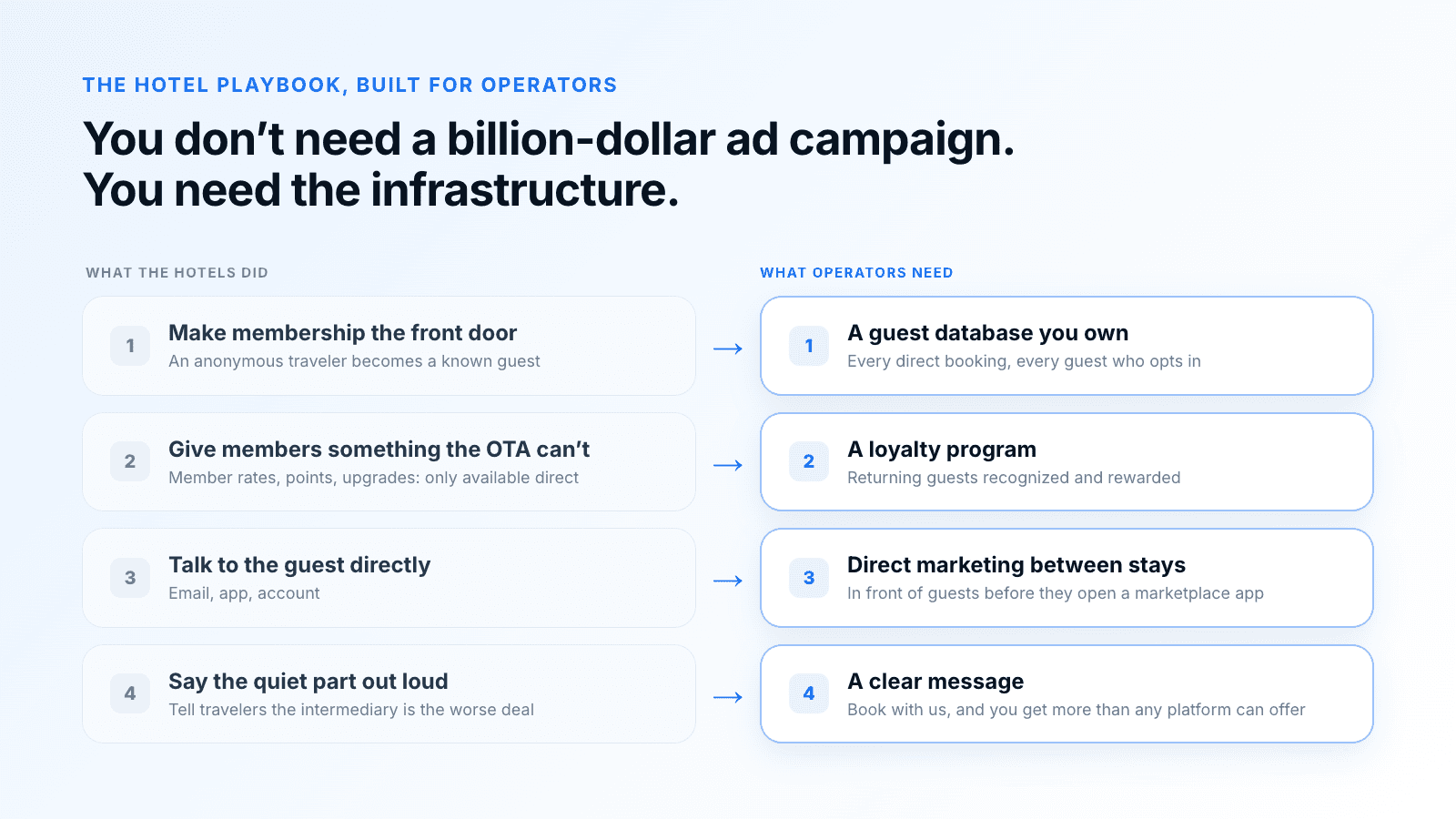
A guest database you own, built from every direct booking and every guest who opts in to hear from you.
A loyalty program, so returning guests are recognized and rewarded for coming back to you.
Direct marketing between stays, so you stay in front of guests long before they open a marketplace app.
A clear message: book with us, and you get more than any platform can offer.
What changes when you think like a hotel brand
Adopting the hotel playbook is not just a set of tactics. It changes how an operator runs the business.
You measure different things. Occupancy and ADR still matter, but they sit alongside direct share, repeat guest rate and the size of your guest base. A hotel brand knows how many members it has. An operator should know how many past guests they can reach directly.
You budget differently. Platform commissions stop being an unavoidable cost of doing business and start being a marketing line item, compared against what it costs to bring a guest back directly. That comparison almost always favors retention.
You design the stay as marketing. Every stay is an audition for the next one. The welcome, the communication, the small touches all exist to create a guest who wants to come back and knows how to reach you.

You negotiate from strength. The more of your revenue comes from guests you own, the less any single platform’s terms can hurt you. That is the position the hotels fought their way into, and it is the position every operator should be working toward.
That is exactly what Yada gives short-term rental and boutique hotel operators — the loyalty, guest data and marketing infrastructure the big chains spent a decade building, without the decade.
The hotels proved that the guest relationship is the business. Operators don’t have to prove it again. They just have to act on it.
See how Yada brings the hotel loyalty playbook to operators →