Klaviyo is excellent at what it does — and what it does is sell more products to Shopify shoppers. Hospitality is a different business with a different mental model. Here's why STR operators who want more than abandoned-cart emails are moving to Yada.
Klaviyo is one of the best marketing platforms in software. We mean that. For Shopify-native ecommerce brands selling physical products to repeat shoppers, the depth of segmentation, the abandoned-cart logic, and the predictive CLV models are genuinely class-leading.
But Klaviyo's entire mental model is built around a transactional, product-shaped customer journey. Browse a product. Add to cart. Abandon. Get the recovery email. Buy. Receive. Reorder six weeks later. That model maps perfectly to skincare, supplements, and shoes.
Hospitality doesn't work that way. A guest is not a shopper. They're not browsing SKUs — they're choosing a place to spend a week of their life. A stay is not a purchase — it's a commitment to a specific date range, party size, and emotional context. An inquiry is not an abandoned cart — it's the beginning of a multi-touch evaluation that may take days or weeks. The signals you need to act on are different. The data you need to capture is different. The journeys you need to send are different.
Most STR operators we talk to who use Klaviyo describe the same experience: they got the platform up and running with a Shopify-style abandoned-cart equivalent for inquiries, and then hit a wall. The depth of automation Klaviyo offers in ecommerce simply doesn't translate to hospitality lifecycles, because the platform doesn't know what a property is, what a stay is, or what a check-in date means.
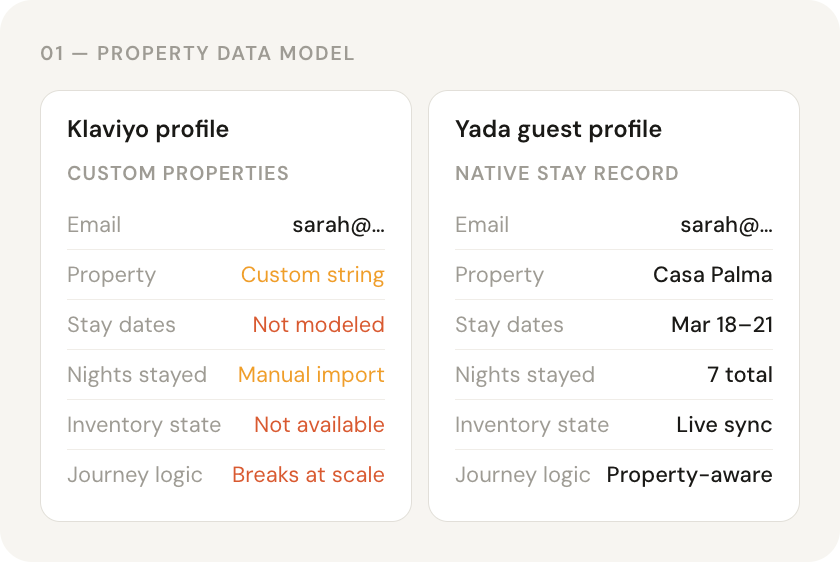
Properties are the most important object in your business — and Klaviyo has no native concept of them. Operators end up forcing properties into custom profile properties, which breaks down the moment you need to do anything sophisticated like inventory-aware recommendations or property-specific journey logic.
Klaviyo's deepest integrations — and most of its predictive features — depend on Shopify-native data. There is no native Guesty, Hostaway, or Hospitable connector. Operators rely on third-party middleware, and the data fidelity is significantly lower than the Shopify pipeline Klaviyo was actually engineered for.
Klaviyo charges by active profile count, regardless of guest engagement or revenue. For STR operators with large past-guest databases — exactly the asset you want to invest in for repeat bookings — this means the cost grows fastest precisely when you're trying to extract more value from existing relationships.
Klaviyo is genuinely strong at email marketing. The gaps aren't about email quality — they're about whether the platform's underlying model fits your business. This comparison focuses on hospitality-specific capabilities, where the differences are structural.
Guest Data Foundation
| Capability | Yada | Klaviyo |
|
Property as a first-class object Inventory tied to guest, stays, calendar, and revenue |
Native Every property has its own profile, calendar, revenue history, and guest list — all queryable. |
Not modeled No native property object. Operators force-fit properties into custom profile fields, which breaks at scale.
|
|
Stay as a first-class object Check-in, checkout, party size, channel of origin
|
Native Every stay is a structured event: dates, property, party, channel, revenue, status — all triggerable.
|
Maps to "order" Klaviyo's data model treats stays as ecommerce orders. Lifecycle logic doesn't translate to date-driven hospitality. |
|
Native PMS integration Guesty, Hostaway, Hospitable, OwnerRez |
Built-in Two-way sync with the major PMS platforms. No middleware, no CSV imports.
|
Third-party only Klaviyo integrates natively with Shopify, BigCommerce, WooCommerce. PMS connections require middleware.
|
MHospitality native triggers and journeys
| Capability | Yada | Klaviyo |
|
Inquiry abandonment recovery Re-engaging direct inquiries that didn't convert |
Native Detects abandoned inquiries by property, dates, and behavior. Triggers contextual recovery sequences with alternatives.
|
Cart-shaped only Abandoned cart logic exists for ecommerce. No native model for inquiry abandonment with property and date context.
|
|
Date-anchored guest journeys Pre-arrival, in-stay, post-stay, anniversary |
Native Journeys triggered by check-in date, checkout date, days-since-stay, return season, and stay number.
|
Manual setup Date-based flows possible via custom properties, but require significant manual configuration per property type.
|
|
Repeat booking prediction Identifying guests likely to return — and when
|
Hospitality model Predictive scoring based on stay patterns, seasonality, party-size shifts, and portfolio behavior.
|
Ecommerce model Predictive CLV exists, but trained on purchase frequency. Doesn't account for travel seasonality or stay context.
|
|
SMS & WhatsApp built-in Multi-channel guest messaging from one inbox |
Native SMS and WhatsApp included. Guest replies route to the same inbox as email.
|
Add-on SMS via paid third-party integrations. WhatsApp via Marketing Hub Enterprise tier or external tools.
|
Guest experience & revenue
| Capability | Yada | Klaviyo |
|
Digital check-in & guidebooks Branded guest portal with property-specific content |
Native Branded check-in flow, in-stay guidebook, upsell menu — all on the unified guest profile.
|
Not in scope Klaviyo doesn't address operational guest experience. Operators bolt on a separate tool (Hostfully, Touch Stay, etc.). |
|
In-stay upsells Late checkout, early arrival, mid-stay clean, F&B |
Native Pre-arrival and in-stay upsell menus with payment processing and revenue tracking.
|
Not supported No mechanism for property-specific paid upgrades or in-stay revenue capture.
|
|
AI guest chat & chat widget Pre-booking and in-stay conversational support |
Native Trained on your properties, your guidebooks, your policies. Hands off to humans when needed.
|
Not in scope No conversational guest support layer. Operators integrate separate chat widgets and lose unified context.
|
Loyalty & Retention
| Capability | Yada | Klaviyo |
|
Points, tiers, and referrals Hospitality-native loyalty program |
Native Points-per-stay, tier structures, referral mechanics, and redemption all built in.
|
Not in scope Loyalty must be built externally. Common pattern: pay for a separate loyalty tool and integrate.
|
|
Repeat booking prediction Identifying guests likely to return — and when |
Native Predictive scoring based on stay patterns, seasonality, and guest behavior across the portfolio.
|
Not supported Predictive lead scoring exists but is built around B2B sales, not stay patterns.
|
What You're Paying For
Klaviyo's pricing model penalizes the asset you should be growing.
For an ecommerce brand, Klaviyo's contact-based pricing makes sense. Each contact represents potential repeat purchase revenue, and the math works.
For an STR operator, the same pricing model creates a perverse incentive. Your most valuable asset — your past guest database — is the lever you want to *invest in*, not pay a monthly tax on. Every guest you've ever hosted is a potential repeat booking, a potential referral, a potential lifetime relationship. You want that database to grow.
Klaviyo's model charges you more as it grows. The same feature set at $20/month with 500 contacts becomes $720/month at 50,000 contacts and $1,350+/month above that. Operators end up purging valuable past-guest data just to manage costs — which is exactly the opposite of what a guest relationship platform should encourage.
Yada's per-listing pricing aligns the cost with the size of your operation, not the size of your guest history. A 50-property operator with 50,000 past guests pays the same as a 50-property operator with 5,000 past guests. The growing relationship list is treated as an asset, not a liability.
Klaviyo is genuinely good at email. If email broadcasts are the only thing you need, it's a defensible choice. But if you're trying to recover abandoned inquiries, run hospitality-shaped journeys, capture in-stay upsells, run a real loyalty program, and unify guest data across the OTAs and your direct channel — you'll be assembling that stack from five vendors instead of running it from one.
Book a 30-minute walkthrough. We'll show you what an integrated hospitality-native platform actually looks like, and where it leaves Klaviyo.